E. Earth and Space Systems · Heat in the EnvironmentRadiation Heats and Cools Earth: The Greenhouse Effect
E2.7 A1.2 A1.5About 50 minutes
Learning goals- I can describe how radiation heats Earth during the day and how Earth cools by giving off radiation.
- I can explain how greenhouse gases absorb and send back some of the heat that Earth radiates.
- I can explain the difference between the natural greenhouse effect and the enhanced greenhouse effect.
- I can use a model and describe its strengths and limits.
Words to know
atmosphere
The layer of gases surrounding Earth.
greenhouse gas
A gas in the atmosphere that absorbs infrared radiation, such as water vapour, carbon dioxide, methane and nitrous oxide.
greenhouse effect
The warming of Earth's surface because greenhouse gases absorb some of the infrared radiation Earth gives off and send part of it back down.
enhanced greenhouse effect
The extra warming caused when human activities add more greenhouse gases to the atmosphere.
energy balance
The balance between the energy Earth absorbs from the Sun and the energy it radiates back to space.
climate change
A long-term change in the usual weather patterns of a place or of the whole Earth.
Remember from Grade 5
In Grade 5 you learned that greenhouse gases act a bit like a blanket around Earth, that we need some of them to stay warm, and that burning fossil fuels adds carbon dioxide and is changing Earth's climate. Now you will use what you know about radiation to explain how this blanket actually works.
A frosty mystery
It is October in Ontario. Two nights in a row, the evening temperature is the same. The first night is cloudy, and in the morning the grass is just wet. The second night is clear and starry, and in the morning the grass is white with frost. Why did the clear night get colder?
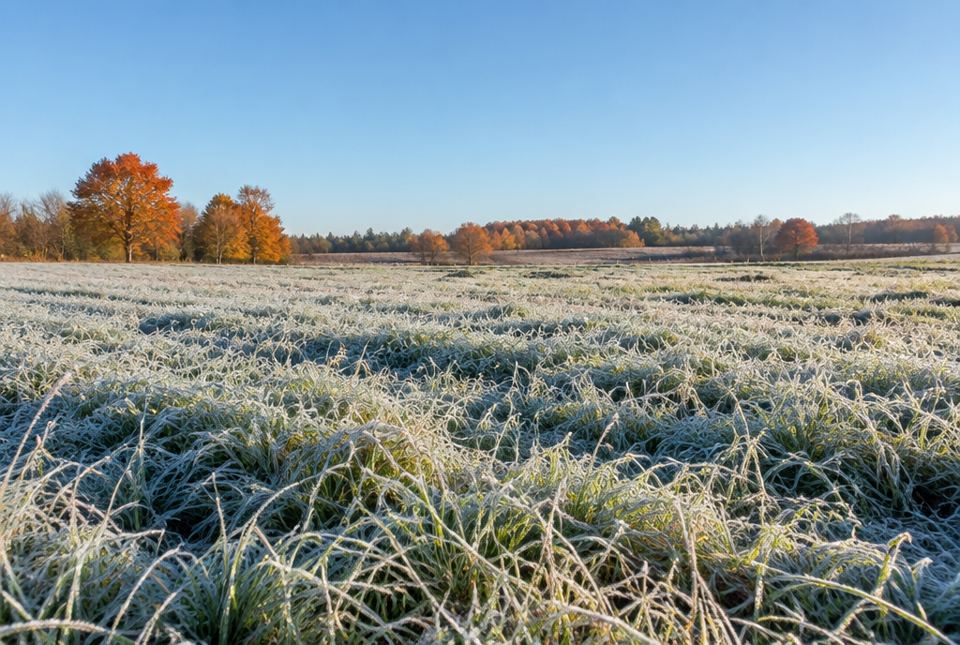 Frost forms most often after clear nights. With no clouds to absorb and send back energy, the ground loses heat to space by radiation and gets very cold. AI-generated image
Radiation in, radiation out
Daytime: sunlight passes through the atmosphere. About 30% of it is reflected straight back to space by clouds, ice, snow and other bright surfaces. Most of the rest is absorbed by the land and oceans, which warm up.
All the time: Earth's warm surface gives off infrared radiation. Some of it escapes to space. This is how Earth cools.
At night: there is no incoming sunlight, but Earth keeps radiating infrared. So the ground and air cool down. The longer the night, the more they cool, which is one reason winter nights in Canada get so cold.
If Earth absorbs as much energy as it gives off, its average temperature stays steady. This is Earth's energy balance.
The greenhouse effect
Some gases in the atmosphere, called greenhouse gases, let most incoming sunlight pass through, but they absorb much of the infrared radiation coming up from Earth's surface. Then they give off that energy in all directions, so some goes back down toward the surface.
The main greenhouse gases are water vapour, carbon dioxide (CO₂), methane and nitrous oxide.
This natural greenhouse effect is essential. Without it, Earth's average surface temperature would be about −18 °C, and most of the planet would be frozen. With it, the average is about 15 °C.
Back to the frost mystery: clouds are made of water droplets, and the air around them holds water vapour. They absorb infrared from the ground and send some back down, like a blanket. On a clear night, more infrared escapes straight to space, so the ground cools faster and frost can form.
The enhanced greenhouse effect
Since the 1700s, people have burned huge amounts of coal, oil and natural gas, and cleared forests. This has added carbon dioxide and other greenhouse gases to the atmosphere. Scientists have measured that carbon dioxide has risen from about 280 parts per million before then to more than 420 parts per million today, an increase of about 50%.
With more greenhouse gases, more infrared is absorbed and sent back down, and less escapes to space. Earth's energy balance is upset: more energy comes in than goes out, so Earth warms. This extra warming is the enhanced greenhouse effect, and it is the main cause of today's climate change.
Why "greenhouse"?
The name compares Earth to a glass greenhouse, but the comparison is not perfect. A real greenhouse stays warm mostly because the glass stops the warm air from rising and blowing away (it stops convection). The atmosphere has no glass roof; greenhouse gases warm Earth by absorbing and re-emitting infrared radiation. Scientists still use the name because everyone knows it.
Worked exampleLet's explain the frost: a cloudy night versus a clear night
Explain why frost is more likely on a clear, calm night than on a cloudy night.
- At night there is no sunlight coming in, but the ground keeps radiating infrared energy.
- On a cloudy night, the clouds and water vapour absorb much of that infrared and send some back down. The ground cools slowly.
- On a clear night, more infrared escapes straight to space. The ground cools quickly.
- If the ground and grass cool below 0 °C, water vapour in the air turns directly into ice crystals on them (deposition): frost.
Without clouds to send infrared radiation back down, the ground loses heat faster on a clear night, so it is more likely to cool enough for frost.
Just for funWithout the natural greenhouse effect, Earth's average temperature would be about −18 °C. Every day would be a snow day... forever. Thanks, water vapour and carbon dioxide (in the right amounts)!
Hands-on activityModel the greenhouse effect with jars (A1.2)
You need: 2 identical clear glass jars or glasses, 2 thermometers that fit inside, clear plastic wrap, an elastic band, a sunny spot (or a desk lamp with an LED bulb), a clock, paper and a pencil.
- Lay a thermometer in each jar so you can read it.
- Cover one jar tightly with plastic wrap and an elastic band. Leave the other open.
- Put both jars side by side in the sun. Record both temperatures at the start.
- Record both temperatures every 5 minutes for 30 minutes. Make a double line graph (A1.5).
- Analyse: which jar warmed up more? Was there a difference at the start?
What to look for: the covered jar usually gets warmer than the open jar.
Thinking about the model: what does the plastic wrap stand for? (The atmosphere and its greenhouse gases.) How is this model like Earth? Energy from the Sun comes in and warms the inside. How is it different? The plastic wrap mainly stops warm air from escaping (it blocks convection), like a real greenhouse. Earth's atmosphere has no lid; greenhouse gases warm Earth by absorbing and re-emitting infrared radiation. Every model has limits, and good scientists say what they are.
Safety: handle glass jars carefully. Never look at the Sun. If you use a lamp, use an LED bulb, keep paper and plastic away from it, and let a grown-up set it up. Do not leave the jars in the sun unattended where children or pets could knock them over.
Your turn
1How does Earth's surface get warmed during the day?
It absorbs radiation (sunlight) from the Sun.
2How does Earth lose energy to space?
By giving off infrared radiation.
3Name four greenhouse gases.
Water vapour, carbon dioxide, methane, nitrous oxide.
4What do greenhouse gases do with the infrared radiation from Earth's surface?
They absorb it and give it off again in all directions, so some goes back down to the surface.
5About what would Earth's average temperature be without any greenhouse effect?
About −18 °C (instead of about 15 °C).
6What is the difference between the natural and the enhanced greenhouse effect?
The natural greenhouse effect keeps Earth warm enough for life. The enhanced greenhouse effect is the extra warming caused by greenhouse gases that humans add.
7Why are clear winter nights usually colder than cloudy ones?
Without clouds to absorb and send back infrared, more heat escapes to space, so the ground cools faster.
More practice: warm-up
1About what percentage of incoming sunlight is reflected back to space?
2Is the natural greenhouse effect good or bad for life on Earth?
Good. Without it, Earth would be far too cold.
3What is the main greenhouse gas added by burning fossil fuels?
4What kind of radiation does Earth's warm surface give off?
5Does Earth stop giving off radiation at night?
No. It keeps radiating infrared, which is why it cools down at night.
More practice: on your own
1Explain what "energy balance" means for Earth.
Earth's temperature stays steady when the energy it absorbs from the Sun equals the energy it radiates back to space.
2Carbon dioxide rose from about 280 to about 420 parts per million. Show that this is an increase of about 50%.
420 − 280 = 140. 140 ÷ 280 = 0.5 = 50%.
3Why do more greenhouse gases make Earth warmer?
More greenhouse gases absorb more infrared and send more back to the surface, so less energy escapes to space. More energy comes in than goes out, and Earth warms.
4Name one way the jar model is like Earth's greenhouse effect and one way it is different.
Like: sunlight passes through the cover and warms the inside, which ends up warmer than without a cover. Different: the plastic wrap mostly stops warm air escaping (convection); Earth's atmosphere has no lid, and greenhouse gases work by absorbing and re-emitting infrared radiation.
5Why is "greenhouse effect" not a perfect name?
A real greenhouse stays warm mainly because its glass blocks warm air from rising away. The atmosphere warms Earth in a different way: by absorbing and re-emitting infrared radiation.
Challenge
1Deserts can be very hot during the day but very cold at night. Use what you know about water vapour to explain why.
Desert air is very dry, with little water vapour and few clouds. At night, Earth's infrared radiation escapes to space easily, because there is little water vapour to absorb it and send it back. So the ground cools quickly.
2The Moon has no atmosphere and is about the same distance from the Sun as Earth. Predict how its temperatures compare with Earth's, and explain.
The Moon has much greater swings: extremely hot where the Sun is shining and extremely cold in the dark. With no atmosphere, there are no greenhouse gases to hold heat in and no air or water to move heat around (no convection).
3Write a short explanation (3 to 4 sentences) of the greenhouse effect for a Grade 4 student, using correct science but simple words.
Sample: "Sunlight shines through the air and warms the ground. The warm ground sends out invisible heat rays. Some gases in the air catch part of that heat and send it back down, like a blanket. That keeps Earth warm enough to live on, but adding too much of these gases makes Earth too warm." Look for: sunlight warms the surface, the surface gives off heat, gases trap and send back some heat, too much causes extra warming.
Quiz
1. How does Earth lose energy to space?
2. What do greenhouse gases do?
3. Without any greenhouse effect, Earth's average temperature would be about...
4. Which is a greenhouse gas?
5. Frost is most likely on a night that is...
6. The enhanced greenhouse effect is caused by...
Big idea (E2.7): Earth warms by absorbing solar radiation and cools by radiating infrared. Greenhouse gases absorb and re-emit some outgoing infrared, keeping the surface warmer. Adding more greenhouse gases upsets Earth's energy balance and causes warming (the enhanced greenhouse effect). The jar model is an investigation (A1.2) with a graph (A1.5) and a discussion of a model's limits.
How to help: on a clear evening, notice how quickly it cools after sunset; check for frost or dew the next morning. Ask your child to draw and explain the greenhouse diagram to you.
Common difficulties:
- Thinking greenhouse gases block sunlight coming in. They mostly let sunlight through and absorb outgoing infrared.
- Thinking all greenhouse effect is bad. The natural effect is essential for life.
- Confusing the greenhouse effect with the ozone hole. They are different issues.
Safety: handle glass carefully; never look at the Sun; adults set up any lamp.
Sources: carbon dioxide levels are from long-term measurements (NOAA, Mauna Loa record and ice cores).