C. Algebra · Patterns, Integers, Equations, Inequalities, Coding and ModellingMath Modelling: Choosing a Plan for the Winter Ski Club
C4 A1About 60 minutes
Learning goals- I can use the modelling process to plan for a real-life situation.
- I can make reasonable assumptions and explain them.
- I can build a model using linear patterns, expressions, equations, inequalities, graphs and code.
- I can check my model, revise it when facts change, and share a recommendation.
Words to know
mathematical model
A way to represent a real situation with math (an equation, a table, a graph, code) so you can analyse it and make predictions.
assumption
Something you decide to treat as true so you can build a model, like "8 trips will happen".
variable
A quantity that can change, like the number of visits.
revise
Change your model when you learn something new or when an assumption changes.
recommendation
Advice based on your model, with reasons.
Remember from Grade 6
In Grade 6 you used the modelling steps to plan a hot chocolate stand for a winter carnival. You made assumptions, built a model with expressions, equations, inequalities and code, and revised it when the facts changed.
In Grade 7 your model can use everything from this unit: constant rates and initial values, comparing linear patterns, equations and inequalities with multiple terms and decimals, and code with counters and sub-programs.
The situation
A Grade 7 class of 24 students wants to start a cross-country ski club. They plan to go to a nearby conservation area on Fridays this winter. The ski centre offers two plans for each student (these prices are made up for this lesson):
- Plan A: a season pass for $45, plus $4 to rent skis each visit.
- Plan B: a day pass for $10 per visit, ski rental included.
The school bus costs $240 for each trip. The school council has given the club $1500 for buses.
Which plan should the class choose? How many trips can they take?
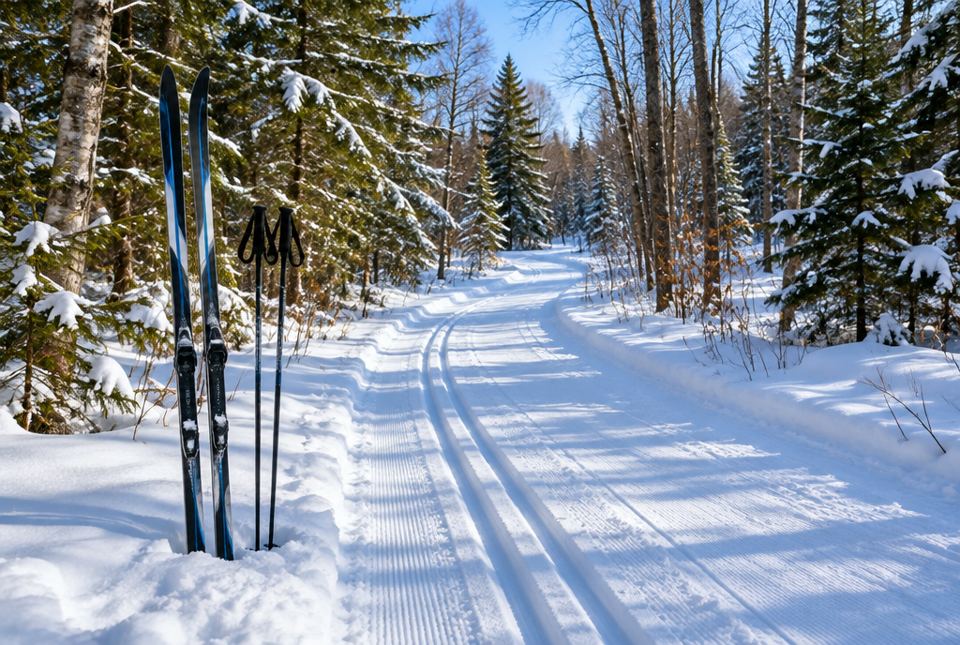 The ski club will visit trails like this one. Things a model cannot control, like snow conditions, are why we make assumptions and revise them. AI-generated imageThe modelling process: 1 Understand, 2 Assume, 3 Model, 4 Check, 5 Share. A dashed arrow goes from Check back to Assume: revise if needed.
1. Understand the problem
What do we know? The prices of the two plans, the bus cost, the bus budget and the class size. What do we need to find? Which plan costs each student less, and how many trips the class can take.
What don't we know? How many Fridays the class will really go. That depends on the weather!
2. Make assumptions
- The ski season for school trips runs about 10 Fridays (mid-January to mid-March).
- Some trips may be cancelled for extreme cold or poor snow. We'll start by assuming 8 trips happen.
- All 24 students go on every trip, and the bus cost is shared equally.
- Prices don't change during the season.
Different groups may make different assumptions. That's OK, as long as you explain them.
3. Model and solve
Let v be the number of visits.
- Plan A: initial value 45, constant rate 4. Cost per student: A = 45 + 4v.
- Plan B: initial value 0, constant rate 10. Cost per student: B = 10v.
When are they equal? Solve 45 + 4v = 10v. Take 4v from both sides: 45 = 6v, so v = 7.5.
When is Plan A cheaper? 45 + 4v < 10v when v > 7.5. Visits are whole numbers, so Plan A is cheaper for 8 or more visits, and Plan B is cheaper for 7 or fewer.
| visits (v) | 5 | 6 | 7 | 8 | 9 | 10 |
|---|
| Plan A: 45 + 4v ($) | 65 | 69 | 73 | 77 | 81 | 85 |
| Plan B: 10v ($) | 50 | 60 | 70 | 80 | 90 | 100 |
| Cheaper plan | B | B | B | A | A | A |
The bus
How many trips does the $1500 budget pay for? 240t ≤ 1500. Boundary: t = 1500 ÷ 240 = 6.25. So the budget covers at most 6 trips.
That changes things! With only 6 trips, Plan B is cheaper: $60 compared with $69.
4. Check and revise
Check: 8 visits on Plan A: 45 + 32 = $77. On Plan B: $80. ✓ Matches the table.
Revise: our first assumption was 8 trips, but the bus budget only allows 6. There are two choices:
- Option 1: take 6 trips and choose Plan B ($60 per student).
- Option 2: raise money for 2 more bus trips. 8 trips cost 8 × 240 = $1920, so the class needs $420 more. Then choose Plan A ($77 per student).
Insight: even with 8 trips, Plan A only saves $3 per student, and if one or two trips are cancelled for cold weather, Plan B would have been cheaper. Plan B is the safer choice when the number of trips is uncertain.
DEFINE COMPARE(v)
SET a = 45 + 4 × v
SET b = 10 × v
IF a < b THEN
SAY v, "visits: Plan A"
ELSE IF b < a THEN
SAY v, "visits: Plan B"
ELSE
SAY v, "visits: same cost"
END DEFINE
SET v = 0
REPEAT 10 times
ADD 1 to v
COMPARE(v)
Code that compares the plans for 1 to 10 visits. It says Plan B for 1 to 7 visits and Plan A for 8 to 10 visits.
5. Share
A good recommendation states the answer, the assumptions and the reasons. For example:
"We recommend Plan B and 6 trips, which the bus budget covers. Each student would pay $60. Plan A only becomes cheaper at 8 or more trips, and only by a few dollars, and cold weather could cancel some trips. If the class raises $420 for two more bus trips and the weather is good, Plan A would save each student $3."
There's more than one good answer
In modelling, two groups can make different assumptions and reach different recommendations. Both can be good, if the math is correct and the reasons are clear. What matters is that you say your assumptions and show how the answer changes if they change.
Worked exampleExample: What if the price changes?
Halfway through planning, the ski centre raises the day pass to $11. Does the recommendation change?
- New Plan B: B = 11v. Plan A stays 45 + 4v.
- Equal when 45 + 4v = 11v: 45 = 7v, v = 6.43 (rounded).
- So Plan A is now cheaper for 7 or more visits. For 6 visits: A = $69, B = $66. B is still cheaper, by $3.
- With 6 trips the recommendation stays Plan B, but the difference is smaller.
Still Plan B for 6 trips ($66 vs $69). If the class takes 7 or more trips, Plan A becomes the better choice.
Just for funA model is only as good as its assumptions. Assume the snow will cooperate all winter, and the weather will happily show you how to revise!
Hands-on activityModel a family winter outing
You need: paper, a pencil, a calculator for checking, and a grown-up to help find real prices.
- Understand: choose a winter activity your family might do several times, like public skating, swimming at a community centre, or tobogganing with hot chocolate afterward. Look up two ways to pay (for example, a single visit or a punch card or membership).
- Assume: how many times will you go this winter? Who will go?
- Model: write an equation for each payment option. Find when they are equal. Make a table or graph.
- Check and revise: what if you go fewer times than you planned? What if a sibling joins?
- Share: write a short recommendation for your family, with your assumptions and reasons.
Tip: if you can't find real prices, use the ski club prices from this lesson.
Your turn
1What are the initial value and the constant rate of Plan A?
Initial value $45 (the season pass). Constant rate $4 per visit (rental).
2Find the cost per student of each plan for 5 visits. Which is cheaper?
A: 45 + 20 = $65. B: $50. Plan B is cheaper.
3Find the cost per student of each plan for 9 visits. Which is cheaper?
A: 45 + 36 = $81. B: $90. Plan A is cheaper.
4Solve 45 + 4v = 10v. What does the answer mean?
45 = 6v, v = 7.5. The plans would cost the same at 7.5 visits. Since visits are whole numbers, B is cheaper up to 7 and A is cheaper from 8.
5Solve 240t ≤ 1500 for the number of bus trips t.
t ≤ 6.25, so at most 6 trips. Check: 6 × 240 = 1440 ≤ 1500, and 7 × 240 = 1680 is too much.
6Name one assumption in the model. How could changing it change the recommendation?
Example: 8 trips happen. If only 6 happen, Plan B is cheaper. Another: all 24 students go every time. If fewer go, the bus cost per student goes up, but it's the same for both plans, so the choice of plan doesn't change.
More practice: warm-up
1Evaluate 45 + 4v when v = 3.
3The bus costs $240 per trip for 24 students. What is the bus cost per student per trip?
4Which plan's graph is steeper, A or B?
B (constant rate 10 > 4).
5What is the first step of the modelling process?
More practice: on your own
1A third option, Plan C, costs $36 plus $6 per visit. When do Plan C and Plan B cost the same?
36 + 6v = 10v gives 36 = 4v, so v = 9. Both cost $90 at 9 visits.
2For 6 visits, which is cheapest: A, B or C?
A: 45 + 24 = $69. B: $60. C: 36 + 36 = $72. Plan B ($60).
3Including the bus ($10 per student per trip), what is each student's total for 6 trips on Plan B?
4Run COMPARE(7) and COMPARE(8) from the code. What does each say?
COMPARE(7): a = 73, b = 70, so "7 visits: Plan B". COMPARE(8): a = 77, b = 80, so "8 visits: Plan A".
5The class raises money by selling hot chocolate at a $1.50 profit per cup. Write and solve an inequality to find how many cups they must sell to raise at least $420.
1.5c ≥ 420. Boundary c = 280. Test c = 300: 450 ≥ 420 ✓. At least 280 cups.
Challenge
1Suppose Plan A's season pass costs $54 instead of $45. How many visits are needed for Plan A to be cheaper than Plan B?
54 + 4v < 10v when 6v > 54, so v > 9. Plan A is cheaper only at 10 or more visits. (At 9 visits they're equal: $90.)
2Alter the COMPARE code so it also says how much money the cheaper plan saves.
Inside COMPARE, after setting a and b: IF a < b THEN SAY v, "visits: Plan A saves", b − a, ELSE IF b < a THEN SAY v, "visits: Plan B saves", a − b, ELSE SAY v, "visits: same cost". For 8 visits it says "Plan A saves 3".
3Write a short recommendation (3 or 4 sentences) for the class if they raise enough money for 10 trips and the weather forecast looks good.
Model answer: "We recommend Plan A. With 10 trips, Plan A costs $85 per student and Plan B costs $100, so each student saves $15. We assumed all 10 trips happen. If 3 or more trips are cancelled (7 or fewer trips), Plan B would have been cheaper, so we should check the forecast before buying passes." Look for: the answer, numbers that support it, the assumption, and what could change it.
Quiz
1. In A = 45 + 4v, what does 45 represent?
2. For how many visits are Plan A (45 + 4v) and Plan B (10v) equal?
3. Which plan is cheaper for 6 visits?
4. Why does the bus cost not change which plan is cheaper?
5. Which is an assumption in the ski club model?
6. What should you do if one of your assumptions turns out to be wrong?
Big idea: Grade 7 students apply the process of mathematical modelling to represent, analyse, make predictions and provide insight into real-life situations (C4). This lesson pulls the whole unit together: linear models with an initial value and constant rate (45 + 4v), comparing two linear patterns, solving equations and inequalities, a graph, and code with a sub-program and a counter.
Common difficulties:
- Giving an answer without assumptions. Ask: "What did you assume? What if that changes?"
- Rounding in context: 7.5 visits and 6.25 trips must be interpreted as whole numbers.
- Expecting one right answer. Different assumptions can lead to different, equally reasonable recommendations.
How to help: Do the family outing activity with real prices from your community centre or local rink. Let your child lead the decision and present it to the family. This lesson builds A1 skills: working through a complex problem, making decisions, and communicating them clearly and respectfully.