B. Foundations of Language · Foundations: Speaking, Listening, Words and FluencySpeaking Precisely: Elaborate, Vary Your Sentences and Choose Your Voice
B1.5 A1.1 A3.1About 45 minutes
Learning goals- I can use precise, descriptive adjectives and adverbs to elaborate when I speak.
- I can use different sentence types on purpose to keep listeners interested.
- I can make my spoken sentences cohesive and coherent with clear pronouns and transitions.
- I can choose the active or passive voice to fit my purpose and audience.
Words to know
elaborate
To add details that make an idea clearer or more vivid.
precise
Exact; the word that says exactly what you mean.
rhetorical question
A question asked for effect, not to get an answer: Who wants to spend recess stuck indoors?
cohesive
Tied together with links like pronouns and transitions, so sentences connect.
coherent
Making sense as a whole; ideas are in a logical order.
active voice
The subject does the action: The volunteers cleared the trail.
passive voice
The subject receives the action: The trail was cleared (by the volunteers).
Remember from Grade 6
In Grade 6 you chose precise words, used cohesive ties (pronouns, transitions) and varied sentences when you spoke, and learned how the active and passive voice change what the listener notices. In Grade 7 you'll pull these tools together and choose them on purpose: which adjective or adverb, which sentence type, which voice, for this audience and this purpose.
Let's start with two weather reports
Version A: "There was a storm. It was very bad. There was a lot of snow. Things were closed. It was very cold."
Version B: "Yesterday's blizzard dumped 35 centimetres of heavy, wet snow on our town. Schools were closed, and buses stayed in the garage. Why? Fierce winds whipped the snow into drifts taller than a car. Stay home today if you can."
Version B uses precise words (blizzard, heavy, wet, fierce), different sentence types (a statement, a question, a command), and the passive voice where it makes sense (Schools were closed: we don't need to know who closed them). Listeners can picture it, and they know what to do.
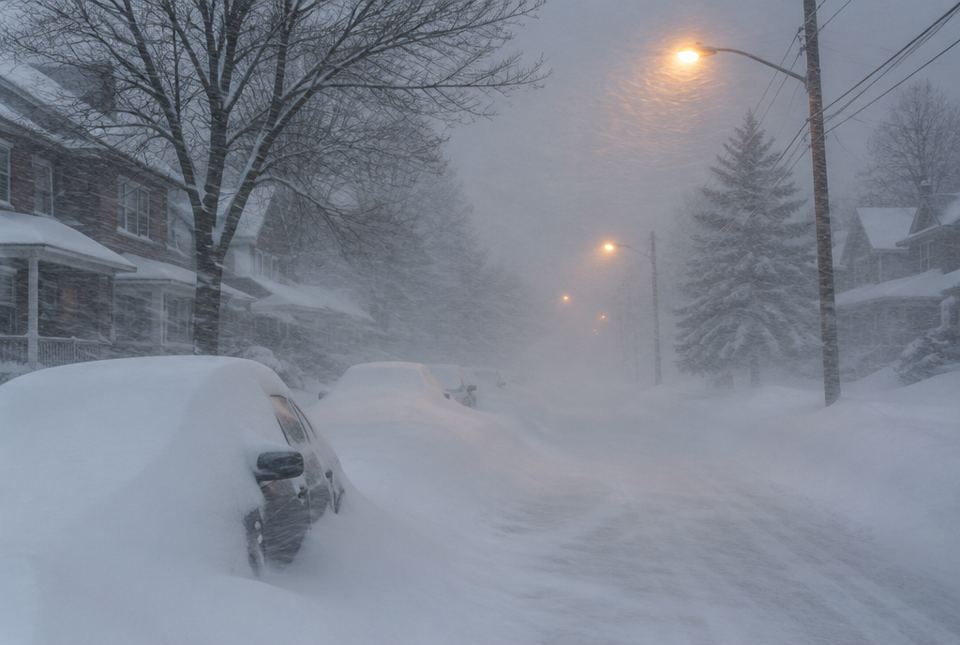 Which weather report helps you picture a scene like this? Precise words such as drifts, whiteout and buried make a listener see it. AI-generated image
Elaborating with adjectives and adverbs
Adjectives describe nouns. Adverbs describe verbs, adjectives or other adverbs (often telling how, when, where or how much).
- Swap vague words for precise ones: nice → patient, generous, cozy; bad → fierce, harmful, disappointing.
- Try a strong word instead of very + a weak word: very cold → frigid; very tired → exhausted; very quickly → rapidly.
- Don't pile up describers. The big, huge, giant, enormous moose says the same thing four times. One well-chosen word is stronger: the enormous moose.
- Put the adverb where it's clear: Carefully, she lifted the injured bird (focus on how) vs. She lifted the injured bird carefully. Both work; the first stresses carefully.
- In a formal talk, an adverb can show how sure you are: probably, clearly, possibly, certainly.
| Sentence type | What it does | Use it to... |
|---|
| Declarative (statement) | Tells | Give information: The trail is 4 km long. |
| Interrogative (question) | Asks | Involve listeners, or ask a rhetorical question: What would our town look like without trees? |
| Imperative (command) | Tells someone to do something | Give a call to action: Sign up by Friday. |
| Exclamatory | Shows strong feeling | Show excitement or surprise, but use rarely: We raised over $900! |
Cohesive and coherent speaking
Listeners can't reread, so your sentences must link clearly.
- Clear pronouns: "Ava told Mia she won" is confusing. Who won? Say "Ava told Mia, 'You won!'" or "Mia won, and Ava told her."
- Transitions show how ideas connect: however (contrast), as a result (effect), for example, meanwhile, in addition.
- Repeat key words on purpose so listeners stay on track: Composting... Composting also...
- Coherent order: problem before solution, cause before effect, oldest to newest.
Active or passive voice?
In the active voice, the sentence starts with the doer. In the passive voice, it starts with the receiver or the result, and the doer is moved to the end (by...) or left out.
| Active | Passive |
|---|
| Focus | the doer | the receiver or the result |
| Example | Our class planted 40 seedlings. | Forty seedlings were planted (by our class). |
Choose active when the doer matters and you want energy and clarity. Most speaking is active.
Choose passive when:
- the doer is unknown: The window was broken overnight.
- the doer is obvious or unimportant: The road was plowed this morning.
- the result is the focus, as in science: The water was heated to 60 °C.
Be careful: the passive can hide responsibility. "Mistakes were made" doesn't say who made them. In an apology, the active is more honest: "I made a mistake."
Worked exampleLet's revise an oral report
Noor's first draft of a 30-second report for the morning announcements:
"The food drive thing is happening. It is a good thing. Food is needed. Bring food. It was started by the Grade 7s. They want it."
- Find vague words: thing, good thing, food, it, they. Replace with precise words: food drive → Winter Food Drive; food → canned soup, pasta and peanut-free snacks.
- Fix pronouns: They want it (who? want what?) → The Grade 7 classes hope to fill 20 boxes.
- Choose the voice: Food is needed (passive hides who needs it) → active: Local families need our help this winter. Keep a passive where the focus is the result: Donations will be delivered to the food bank on December 18.
- Vary sentence types: add a rhetorical question and finish with a command.
- Add transitions so it flows: This year... In addition... So...
"Good morning! Did you know that many local families need extra help this winter? This year, the Grade 7 classes are running the Winter Food Drive. We hope to fill 20 boxes with canned soup, pasta and peanut-free snacks. In addition, donations will be delivered to the food bank on December 18. So please bring one item to your classroom by Friday!"
Just for funWho ate the last cookie?
"The cookie was eaten." Nice try, passive voice. We still don't know who did it!
The 'which word?' habit
When you practise a talk, listen for very, really, thing, stuff, good, bad, nice. Each one is a chance to choose a more precise word.
Hands-on activityDescribe it, don't name it
You need: 6 to 10 household objects in a bag or box (for example a mitten, a wooden spoon, a toque, a flashlight, a pine cone, an orange; nothing sharp or breakable), and a partner.
- Take turns. Without letting your partner see, pull one object out of the bag and keep it hidden.
- Describe it for 30 seconds using precise adjectives and adverbs, but never say its name. Banned words: thing, stuff, nice, very.
- Your partner guesses. Then switch roles.
- Round 2, voice: pretend to be a news anchor. Describe something that happened at home today twice, once in the active voice (Dad shovelled the driveway) and once in the passive (The driveway was shovelled). Discuss which fits a news report better and why.
What to look for: precise describers (fuzzy, wooden, cylindrical, smoothly), no banned words, and a reason for each voice choice.
Your turn
1Replace very + a weak word with one strong word: (a) very big, (b) very hungry, (c) very scared.
Examples: (a) enormous / huge; (b) starving / ravenous; (c) terrified.
2Name the sentence type: Bring your skates on Friday.
3Write a rhetorical question to open a talk about litter in the park.
Example: "Who wants to play soccer on a field covered in chip bags?"
4Fix the unclear pronoun: Jordan called Theo after he got home.
Example: "After Jordan got home, he called Theo." (or After Theo got home, Jordan called him.)
5Change to the active voice: The rink was flooded by the volunteers.
The volunteers flooded the rink.
6Why might a scientist say "The water was heated to 60 °C" instead of "I heated the water to 60 °C"?
The result (the water and its temperature) is the focus, and who did it is not important.
7Add one adjective and one adverb to elaborate: The dog ran across the ice.
Example: The excited dog ran clumsily across the slippery ice.
More practice: warm-up
1Is carefully an adjective or an adverb?
An adverb (it tells how).
2Name the sentence type: Is the library open today?
Interrogative (a question).
3Active or passive? The school was built in 1962.
4Give a more precise word for nice to describe a sweater.
Examples: cozy, warm, soft, colourful.
5Name one transition that shows contrast.
Examples: however, but, on the other hand.
More practice: on your own
1Fix the adjective pile: We saw a tiny, little, small, wee chipmunk.
We saw a tiny chipmunk. One precise adjective is enough.
2Explain why "Mistakes were made" might be a poor choice in an apology.
It's passive and hides who made the mistakes, so it sounds like the speaker is avoiding responsibility. "I made a mistake" is clearer and more honest.
3Rewrite to make it cohesive with a transition: We practised every day. We won the tournament.
Example: "We practised every day. As a result, we won the tournament."
4Why do short sentences after long ones add emphasis when speaking?
The sudden change in rhythm makes listeners notice the short sentence, so the idea stands out.
5Change to the passive voice and say when this version would be better: Someone stole my bike.
My bike was stolen. Better when you don't know who did it; the focus is on the bike.
Challenge
1Rewrite this into a stronger 3-sentence talk opening, using a question, a precise adjective and a command: Recycling is good. You should do it. It helps.
Example: "Did you know that our school fills a dumpster every week? Much of that garbage could be recycled into new, useful products. Starting today, put your bottles and paper in the blue bins."
2A news reporter says, "The new arena was opened on Saturday by the mayor." A student says, "The mayor opened the new arena on Saturday." Explain how the voice changes the focus, and when each is a better choice.
The passive puts the arena first, so the focus is the arena, which is good for a story mainly about the arena. The active puts the mayor first, which is better if the story is about what the mayor did. Both are correct; the purpose decides.
3Explain the difference between cohesive and coherent with an example.
Cohesive means sentences are linked (pronouns, transitions). Coherent means the whole talk makes sense in a logical order. Example: "First, the sap is boiled. However, before that, the trees are tapped." uses transitions (cohesive) but the order is confusing (not very coherent). Putting tapping first fixes it.
Quiz
1. Which is the most precise way to describe a cold day?
2. Which sentence is a rhetorical question?
3. Which sentence is in the passive voice?
4. When is the passive voice a good choice?
5. Which sentence has an unclear pronoun?
6. Which sentence type makes a call to action?
Big idea (B1.5, A1.1, A3.1): Grade 7 students use precise and descriptive word choice (including varied adjectives and adverbs), a variety of sentence types, cohesive and coherent sentences, and the active or passive voice as appropriate when speaking, to support audience understanding. Grammar terms are taught in more depth in the companion unit Foundations of Writing.
How to help at home:
- Play "Describe it, don't name it" with grocery items or toys.
- When your child tells you about their day, ask follow-ups that invite precise words: "What kind of...? How exactly...?"
- Point out passive voice in news headlines and talk about why it was chosen.
Common difficulties:
- Overusing adjectives. Encourage one strong word instead of several weak ones.
- Confusing passive voice with past tense. "The dog barked" is past tense but active; "The dog was walked" is passive.
- Unclear pronouns. Ask "Who's 'he'?" when you hear one.