A. Literacy Connections and Applications / C. Comprehension: Understanding and Responding to Texts · Understanding and Responding to TextsSummarizing, Drawing Conclusions and Reflecting on My Reading and Thinking Skills
C2.6 C2.7 C3.8 A1.2About 45 minutes
Learning goals- I can summarize and record the main idea and the most important supporting details of a text.
- I can draw well-supported conclusions and reject conclusions that go beyond the evidence.
- I can explain and compare how strategies like visualizing, predicting, summarizing and connecting helped me understand.
- I can compare the critical thinking skills I used, identify which ones worked best and explain why.
- I can set a specific goal and a plan to improve my comprehension.
Words to know
summary
A short version of a text, in your own words, that gives the main idea and only the most important details.
main idea
What a whole text is mostly about: the big point the writer wants you to understand.
supporting details
Facts, examples and explanations that back up the main idea.
conclusion
A judgment you make by thinking about all the evidence in a text.
well-supported
Backed by several pieces of evidence, without going further than the evidence allows.
critical thinking skills
Ways of thinking carefully about a text, such as questioning the source, weighing evidence, comparing perspectives and noticing what's missing.
reflection
Thinking back on how you learned, what worked and what you could do better.
Remember from Grade 6
In Grade 6 you summarized texts, drew well-supported conclusions, compared strategies and set goals.
In Grade 7 you'll record summaries in an organized way, test conclusions more strictly, and compare your critical thinking skills, not just your reading strategies, to find which ones work best for you.
Hook: The 50-word challenge
Could you explain a whole movie, a hockey game or a school trip in 50 words or fewer? You'd have to decide what really matters. That's the heart of summarizing. Try it with the article below.
Falcons on the Skyline (an article written for this website)
A peregrine falcon is about the size of a crow, but it hunts like a fighter jet. It climbs high, folds its wings and dives at other birds, reaching speeds that can be more than 300 km/h.
In the mid-1900s, peregrine falcons almost disappeared from eastern North America. Scientists discovered why. A pesticide called DDT was being sprayed on crops and in towns. It built up in the bodies of the birds that falcons ate, and then in the falcons themselves. Falcons with DDT in their bodies laid eggs with thin shells that cracked when the parents sat on them. Few chicks hatched.
During the 1970s, Canada and the United States restricted the use of DDT. Then people went further. They raised young falcons and released them into the wild. Some were released from the tops of tall city buildings, because skyscrapers are a lot like the cliffs where peregrines naturally nest, and cities have plenty of pigeons to eat.
Today, peregrine falcons nest again in many parts of Ontario, including on buildings and bridges in cities. Volunteers watch over nests, and some nests have webcams so people can watch the chicks grow. The species is still watched carefully, but its return is one of Canada's conservation success stories.
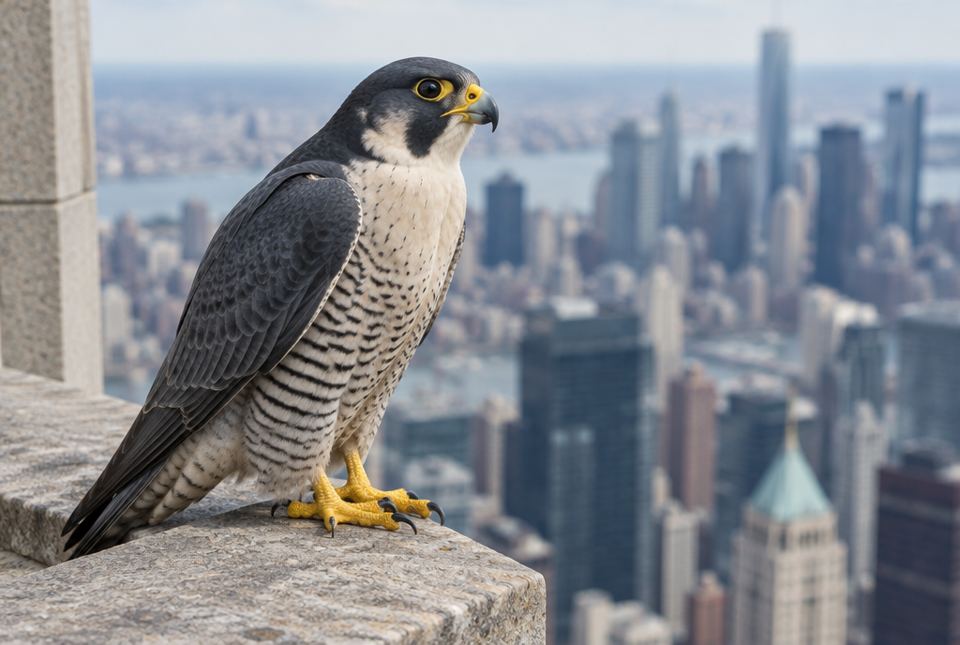 Peregrine falcons now nest on tall buildings in cities. When you summarize the article, decide which details, like this nesting site, are key and which are extra. AI-generated image
How to summarize
- Find the main idea. Check the title, the first paragraph and the last paragraph, and ask: What is the whole text mostly about?
- Pick the key supporting details. Keep the ones that explain or prove the main idea. Leave out interesting extras (like the falcon's speed) unless they're essential.
- Use your own words and keep the order that makes sense (here, the order of events: problem, cause, actions, result).
- Record it in a form that fits: a short paragraph, a numbered list, or an organizer like the one below.
Worked exampleLet's summarize *Falcons on the Skyline*
Write a summary of the article in 50 words or fewer.
- Main idea (from the title and last paragraph): peregrine falcons nearly disappeared but have made a comeback.
- Key details, in order: DDT made falcons lay thin-shelled eggs; DDT was restricted in the 1970s; people raised and released young falcons, some from city buildings; falcons now nest again in Ontario, including in cities.
- Leave out: the falcon's dive speed, the size comparison and the webcams. They're interesting, but they don't explain the decline or the comeback.
- Write it in my own words and count: Peregrine falcons almost vanished in the mid-1900s because the pesticide DDT made their eggshells thin. After DDT was restricted in the 1970s, people raised and released young falcons, some from city buildings. Today falcons nest again across Ontario, a conservation success story. (42 words)
A 42-word summary that gives the main idea (decline and comeback) and the four key details in order, in the reader's own words.
Just for funThe 50-word challenge, extreme edition: summarize your whole weekend in three words. (Sample answer: Slept. Ate. Repeat.)
A summary organizer for Falcons on the Skyline: the main idea at the top, three key supporting details in the middle, and a conclusion built from the evidence at the bottom.Drawing well-supported conclusions
A conclusion is your judgment about what the evidence means. A well-supported conclusion:
- rests on several pieces of evidence,
- does not go further than the evidence allows, and
- does not ignore evidence that goes against it.
Worked exampleLet's test three conclusions
Which conclusion about the article is well-supported?
- A. Peregrine falcons are no longer in any danger.
- B. Human actions can harm a species and can also help it recover.
- C. Peregrine falcons prefer cities to cliffs.
- A ignores evidence: the article says the species is still watched carefully. It goes too far.
- B uses several pieces of evidence: people harmed falcons with DDT, then helped them by restricting DDT and releasing young birds. It stays within what the text shows.
- C goes beyond the evidence: the article says buildings are like cliffs and cities have food, but never says falcons prefer cities.
- Check: Is there anything that contradicts B? No.
Conclusion B is well-supported. A ignores evidence, and C claims more than the text says.
Reflecting on strategies and critical thinking skills
Good readers think about how they understand. In this unit so far you have used reading strategies:
- Visualizing (picturing raindrops pocking the lake in After the Haze)
- Predicting and posing checking questions
- Summarizing (the 50-word challenge)
- Connecting to experience and other subjects (using science to understand lightning safety)
You also use critical thinking skills, which go deeper:
- Questioning the source: Who wrote this? How do they know?
- Weighing evidence: Which conclusion has the most support?
- Comparing texts and perspectives: How do the two posters differ, and why?
- Noticing what's missing: Whose voice or what information is left out?
- Spotting persuasive techniques: How is this opinion column trying to convince me?
Different skills work best for different texts. Compare them: Which helped most, with which kind of text, and why?
| Skill or strategy | Text it helped with | Why it was effective |
|---|
| Predicting with checking questions | After the Haze (a story with suspense) | It kept me reading closely, looking for specific evidence. |
| Summarizing in 50 words | Falcons on the Skyline (an article with many facts) | It forced me to separate the main idea from interesting extras. |
| Weighing evidence | Testing conclusions A, B and C | It stopped me from accepting a conclusion that sounded right but went too far. |
| Comparing texts | The two cleanup posters | Putting them side by side showed choices I wouldn't notice in just one. |
Worked exampleLet's set a goal and a plan
Jonah notices that when he summarizes, he includes almost every detail and his summaries are as long as the text. Write a goal and a plan for him.
- Name the problem clearly: My summaries include too many details, so they're too long.
- Make the goal specific and measurable: For the next three articles I read in science, I will write summaries of 50 words or fewer.
- Plan the steps: First, I'll write the main idea in one sentence. Then I'll highlight only details that explain the main idea. I'll count my words.
- Plan how to check: I'll ask my teacher or a family member whether my summary still gives the main idea.
- Connect to his voice and agency: Jonah chose this goal himself because he wants his science notes to be faster to study from.
Goal: summaries of 50 words or fewer for the next three science articles. Plan: main idea sentence first, highlight only essential details, count words, get feedback.
Retell, summary or conclusion?
A retell gives the events or facts in order with lots of detail. A summary gives only the main idea and key details, briefly, in your own words. A conclusion is your judgment about what all the evidence means.
Hands-on activitySummary challenge and skill reflection
You need: a short news article, magazine article or textbook page; a highlighter or pencil; paper; a timer.
- Read the article. Write its main idea in one sentence.
- Highlight only the details that explain or prove the main idea.
- Write a summary of 50 words or fewer. Then challenge yourself to cut it to 25 words. What did you have to leave out?
- Write three possible conclusions: one well-supported, one that goes too far, and one that ignores evidence. Ask a family member to guess which is which.
- Make a reflection chart like the one in this lesson with three strategies or skills you used this week. Circle the one that helped most and explain why.
- Write one goal with a clear plan and a date to check your progress.
Your turn
1What is the main idea of Falcons on the Skyline?
Peregrine falcons nearly disappeared from eastern North America because of DDT, but they have made a comeback with human help.
2Why did DDT cause falcon numbers to drop? Explain the chain.
DDT built up in the birds that falcons ate, then in the falcons. Falcons then laid eggs with thin shells that cracked when the parents sat on them, so few chicks hatched.
3Why were some young falcons released from city buildings?
Tall buildings are like the cliffs where peregrines naturally nest, and cities have plenty of pigeons to eat.
4Is the falcon's dive speed an important detail for a summary of the decline and comeback? Explain.
No. It's interesting, but it doesn't explain why falcons declined or how they came back, so it can be left out.
5Why is the conclusion Peregrine falcons are no longer in any danger not well-supported?
It ignores evidence: the article says the species is still watched carefully.
6Name one reading strategy and one critical thinking skill you used in this lesson.
Strategy: summarizing (or visualizing, predicting, connecting). Critical thinking skill: weighing evidence to test conclusions (or questioning the source, comparing).
More practice: warm-up
1What two things must a summary include?
The main idea and the most important supporting details.
2Should a summary be in the author's words or your own?
3What pesticide harmed peregrine falcons?
4Where do peregrines naturally nest?
5Is a conclusion a fact stated in the text or your own judgment?
Your own judgment, based on evidence.
More practice: on your own
1What is the difference between a retell and a summary?
A retell gives events or facts in order with lots of detail. A summary gives only the main idea and key details, briefly.
2Write a one-sentence summary of After the Haze (Lesson 4).
Sample: When a thunderstorm comes up during a canoe trip, Priya's experienced Aunt Rosa gets them safely off the lake and makes impatient Priya wait the full 30 minutes, which Priya realizes was worth it.
3Why should you check the last paragraph when looking for the main idea?
Writers often sum up or state their big point at the end. In Falcons on the Skyline, the last paragraph calls the return a conservation success story.
4Give an example of a goal that is too vague, and rewrite it so it is specific.
Vague: I'll be a better reader. Specific: For the next two weeks, I'll pose two checking questions for every chapter of my novel and write whether they were confirmed.
5Why might weighing evidence be more useful than visualizing when reading an opinion column?
An opinion column is trying to persuade, so you need to judge whether its evidence really supports the claim. Visualizing helps more with descriptive texts and stories.
Challenge
1Write a summary of Falcons on the Skyline in 25 words or fewer. Explain what you cut and why.
Sample (24 words): DDT made peregrine eggshells thin, so falcons nearly vanished. After DDT was restricted and young falcons were released, they returned to nest across Ontario. I cut the building and city details and the volunteers, keeping only the cause of decline, the two main actions and the result.
2Write your own well-supported conclusion about Falcons on the Skyline that is different from Conclusion B. List the evidence that supports it.
Sample: Recovering a species can take many kinds of action, not just one. Evidence: people restricted DDT, raised and released young falcons, and volunteers watch nests. (Any conclusion supported by several pieces of evidence and not going beyond them.)
3Compare two critical thinking skills you used in this unit. Which worked best for you, with which kind of text, and why? Then set a goal for the skill you find hardest.
Sample: Comparing texts worked best for media texts like the two posters, because seeing them side by side showed me choices I'd miss in one. Questioning the source is harder for me because I forget to check who wrote things. Goal: for the next five websites I use for school, I'll write down who made the site and why they might have made it before taking notes. (Look for a comparison, a reason and a specific goal with a plan.)
Quiz
1. Which sentence is the best summary of Falcons on the Skyline?
2. Which conclusion goes beyond the evidence?
3. Which is a critical thinking skill rather than a basic reading strategy?
4. Which goal is the most specific?
5. What should you leave out of a summary?
6. A well-supported conclusion...
What this lesson teaches: Grade 7 students summarize and record the main idea and supporting details of texts and draw well-supported conclusions (C2.6). They explain and compare how strategies helped them understand and set goals (C2.7), compare the critical thinking skills they used, identifying which were most effective and why (C3.8), and make a plan to develop their capabilities (A1.2).
How to help at home:
- After a movie or a news story, play the 50-word challenge together.
- When your child states a conclusion, ask: "What's your evidence? Is there anything that goes against it?"
- Help your child check in on their reading goal after a week or two.
Common difficulties:
- Summaries that are too long. Encourage writing the main idea first, then adding only details that support it.
- Conclusions that go too far. Ask: "Does the text actually say that, or are you adding something?"
- Vague reflections (It helped me). Push for how and why.
About the text: Falcons on the Skyline was written for this site. The facts are accurate: peregrine falcons declined sharply in the mid-1900s because DDT built up in the food chain and caused thin eggshells; the use of DDT was restricted in Canada and the United States in the 1970s; captive-bred young falcons were released, including from city buildings; peregrines now nest on buildings and bridges in Ontario cities; dive speeds of more than 300 km/h are widely reported.