A. Physical Patterns in a Changing World · Physical Patterns in a Changing WorldDifferent Peoples, Similar Environments: Perspectives and Sustainability
A1.4 A1.2 A1.1About 50 minutes
Learning goals- I can compare how different peoples living in similar physical environments have responded to their challenges and opportunities.
- I can assess how sustainable those responses are.
- I can compare and contrast the perspectives of different groups on the challenges and opportunities of the natural environment.
Words to know
sustainable
Meeting people's needs today without harming the ability of future generations to meet theirs.
perspective
A point of view, shaped by a person's or group's experiences, values, needs and interests.
nomadic
Moving from place to place, often with animals, to find water and pasture.
pastoralism
A way of life based on raising herds of animals.
Inuit Qaujimajatuqangit
Inuit traditional knowledge, values and ways of knowing, passed down and still used today.
hydroelectricity
Electricity made by the force of moving water, often at a dam.
stakeholder
A person or group affected by a decision, or who has an interest in it.
Same environment, different choices
Two groups of people can live in the same kind of environment, like a hot desert, and respond in completely different ways. One way might last for centuries. Another might use up a resource in a few decades. How do we judge which responses are sustainable?
In this lesson you'll compare responses and the perspectives of different groups.
Comparison 1: Hot deserts
Sahara Desert (Africa): Some families among the Tuareg and other peoples of the Sahara practise nomadic pastoralism. They move with camels, goats and sheep to find water and grazing, so no single place is overused. Other communities live at oases, growing date palms and other crops with groundwater.
Mojave Desert (United States): Las Vegas is a big city in the desert. Most of its water comes from the Colorado River, stored in Lake Mead behind the Hoover Dam. The city has green parks, hotels with fountains, and many homes. During long droughts, Lake Mead's water level has dropped a lot, and the city has paid people to replace lawns with desert plants and has strict water rules.
Assessing sustainability: Nomadic herding uses resources lightly and moves before they run out, but it is under pressure from drought, borders and changes in land use. Las Vegas supports millions of people, but it depends on a river shared with other states and Mexico, and on rain and snow far away. Its water saving has helped, but its future depends on how the river is shared.
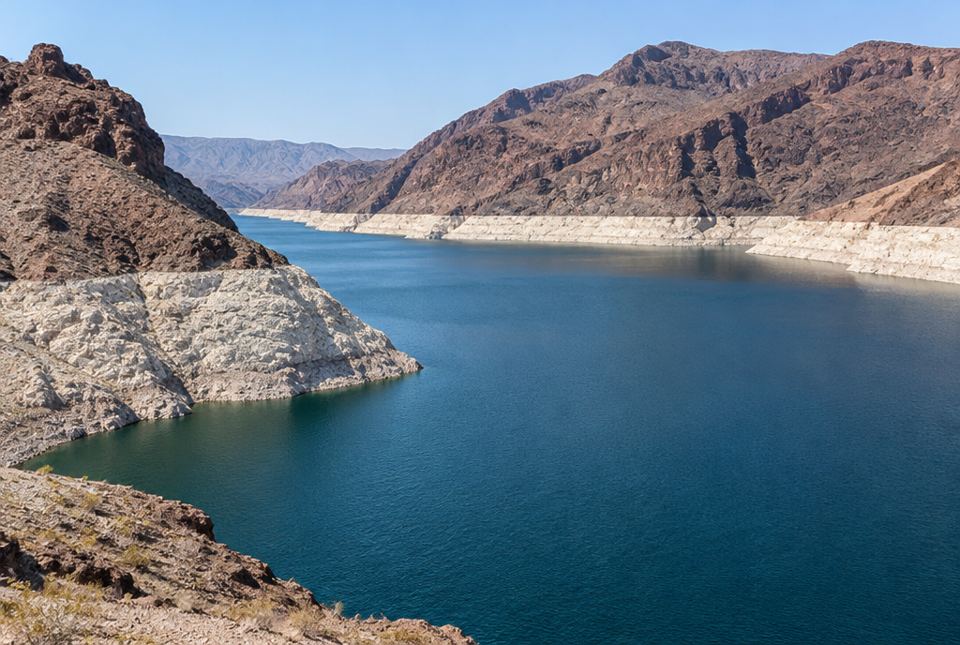 The pale "bathtub ring" shows how much higher the water used to be. A big city using a desert reservoir faster than it refills is a sustainability problem. AI-generated image
Comparison 2: Low-lying coasts
The Netherlands: about a quarter of the land is below sea level. After a deadly storm flood in 1953, the country built the Delta Works, a huge system of dams, dikes and storm barriers. It is now also giving some rivers more room to flood safely.
Bangladesh: much of the country is a low, flat delta. Many families live with seasonal floods: they raise homes on earth mounds, use floating gardens (rafts of plants that rise with the water), and the country has built cyclone shelters and early-warning systems that have helped save many lives.
Assessing sustainability: the Netherlands' approach is very protective but very expensive and must keep growing as seas rise. Bangladesh's approach works with the water and costs less, but rising seas and stronger storms are making life harder for many families.
Comparison 3: The Arctic
Inuit have lived in the Arctic for thousands of years and live there today in communities across Inuit Nunangat, the Inuit homeland in Canada. Inuit Qaujimajatuqangit (Inuit knowledge) includes deep understanding of sea ice, weather, animals and the land. Many families hunt and share country food such as seal, caribou and Arctic char, alongside store-bought food. Modern homes are often built on piles (posts) so their heat doesn't thaw the permafrost underneath.
Sámi in northern Norway, Sweden, Finland and Russia are also Indigenous to a cold northern environment. Some Sámi families herd reindeer, moving with the herds between seasonal pastures.
Assessing sustainability: both ways of life are built on knowing the land well and taking only what is needed, which has helped them last a long time. Both now face challenges from climate change, which is making sea ice and snow less predictable, and from mines, roads and other development on their lands.
Respectful language
First Nations, Métis and Inuit peoples, and Indigenous peoples around the world, are living peoples whose ways of life include both traditional knowledge and modern life. Use the names communities use for themselves, such as Inuit (not "Eskimo") and Cree or Eeyou in the James Bay region.
Different perspectives: the James Bay hydroelectric project
In the 1970s, the Quebec government began a huge hydroelectric project on rivers flowing into James Bay. These are the lands of the Cree (Eeyou) and Inuit. Dams and reservoirs would flood large areas of land used for hunting, trapping and fishing.
The Cree and Inuit went to court to protect their lands. In 1975, they signed the James Bay and Northern Quebec Agreement with the Quebec and federal governments. It is often called the first modern treaty in Canada. Later, in 2002, the Cree and Quebec signed another agreement known as the Paix des Braves.
The flooding also had long-term effects that were not fully expected, such as higher levels of mercury in fish from the new reservoirs, which affected a traditional food source.
| Group | Possible perspective | Why |
|---|
| Cree and Inuit communities | Concern about lost hunting, trapping and fishing land; a right to decide about their lands; interest in jobs and fair benefits | The land supports their food, culture and way of life, and they have rights to it |
| Quebec government and the hydro company | Support | Clean, renewable electricity, jobs and money from selling power |
| Electricity users in cities | Mostly support | Reliable, lower-cost electricity |
| Environmental organizations | Concern | Flooded habitat, changes to rivers, mercury in fish |
Worked exampleLet's assess sustainability with criteria
Assess whether Las Vegas's response to its desert environment is sustainable. Use three criteria: environment, people's needs now, and future generations.
- Environment: the city takes a lot of water from the Colorado River, a river shared by millions of people, farms and wildlife; Lake Mead's level has dropped during drought. → Concern.
- People's needs now: it supplies water to a large city, and water rules and lawn replacement have reduced how much each person uses. → Mostly met, with effort.
- Future generations: if droughts continue and the climate warms, there may not be enough river water for everyone who shares it. → Uncertain.
- Conclusion: partly sustainable; it has improved with water saving, but it still depends on a shared, shrinking water supply.
Las Vegas's response is only partly sustainable: it meets needs today and is saving water, but it depends on a river that may not supply enough water in the future.
Just for funFunny but true: in parts of Bangladesh, some vegetable gardens float on rafts. When the flood water rises, the garden just rides up with it, like a garden in an elevator.
Hands-on activityStakeholder role-play
You need: 4 index cards or slips of paper, a pencil, and at least one other person (a grown-up, sibling or friend), or play all roles yourself.
- The situation: a company wants to build a dam on a river near a small town. The reservoir would flood forest and some hunting areas of a nearby First Nation. The dam would make clean electricity and create jobs.
- Write one stakeholder on each card: the First Nation, the electricity company, people in the town, an environmental group.
- For each card, write: What does this group need? What might it worry about? What might it gain?
- Hold a short meeting. Each person speaks for one group for one minute.
- Together, suggest a decision that respects the most perspectives (for example: the First Nation must give consent, share decisions and benefits; a smaller dam; a different site).
What to look for: your child explains why each group sees things differently, and respects views they don't share.
Your turn
1What does sustainable mean?
Meeting people's needs today without harming future generations' ability to meet their needs.
2How does nomadic pastoralism help avoid overusing the land?
Herders move with their animals, so no single place is overgrazed and plants and water sources can recover.
3Where does most of Las Vegas's water come from?
The Colorado River, stored in Lake Mead behind the Hoover Dam.
4Name two ways families in Bangladesh live with floods.
Any two: homes raised on earth mounds, floating gardens, cyclone shelters, early warnings.
5Why are many Arctic homes built on piles?
So the building's heat doesn't thaw the permafrost underneath, which would make the ground soft and damage the building.
6What agreement did the Cree and Inuit sign in 1975 about the James Bay project?
The James Bay and Northern Quebec Agreement, often called the first modern treaty in Canada.
A point of view, shaped by a person's or group's experiences, values, needs and interests.
More practice: warm-up
1What is hydroelectricity?
Electricity made by moving water, often at a dam.
2What is the Inuit homeland in Canada called?
3What did the Netherlands build after the 1953 flood?
The Delta Works (dams, dikes and storm barriers).
4What animals do some Sámi families herd?
A person or group affected by or interested in a decision.
More practice: on your own
1Compare the Netherlands' and Bangladesh's responses to living in a low-lying delta. Give one strength of each.
Netherlands: strong protection from dikes and storm barriers, so floods rarely reach homes. Bangladesh: works with the water (raised homes, floating gardens, cyclone shelters) at lower cost, and warnings have saved many lives.
2Why might Cree hunters and electricity users in a city have different perspectives on a new dam?
They are affected differently: the hunters could lose land used for food and culture, while city users mainly gain cheaper, reliable electricity and may never see the flooded land.
3Explain one unexpected long-term effect of the James Bay reservoirs.
Mercury levels rose in fish from the new reservoirs, affecting a traditional food source for Cree communities.
4Is Inuit hunting of seals and caribou for food sustainable? Explain using criteria.
It is generally sustainable: it is based on deep knowledge of animals and the land, people take what is needed and share it, and it has supported communities for thousands of years. Challenges such as climate change and pressures on some animal populations mean it must keep being managed carefully, often through Inuit-led co-management.
5Why is it important to include the perspectives of Indigenous peoples when deciding about projects on their lands?
Because they have rights to their lands (often protected by treaties), they are most directly affected, and their knowledge of the land can help make better, more sustainable decisions.
Challenge
1Choose one of the three comparisons (deserts, low-lying coasts, Arctic). Write a short paragraph assessing which response is more sustainable, using at least two criteria.
Sample (deserts): Nomadic herding in the Sahara is more sustainable for the environment, because it uses water and grazing lightly and moves before they run out. Las Vegas meets the needs of many more people now, but it depends on a shrinking shared river, so it is less certain for future generations. Overall, herding is more sustainable, though it is under pressure from drought. Any answer with two criteria and a clear conclusion is acceptable.
2Rising sea levels will affect both the Netherlands and Bangladesh. Which country do you think will find it harder to adapt? Explain.
Many would argue Bangladesh, because it has more people living on low land, less money for huge barriers, and faces strong cyclones. The Netherlands is wealthier and already has a large protection system, though it too must keep raising defences. Any well-supported answer is acceptable.
3In the stakeholder activity, a decision must be made. Suggest a fair process, not just a decision.
Sample: share information with everyone early; hold meetings in the community; the First Nation's consent is required for projects on its lands; study the environmental effects independently; consider alternatives (smaller dam, other site, other energy); agree on how benefits (jobs, money, electricity) are shared; keep checking effects over time.
Quiz
1. A sustainable response...
2. Las Vegas gets most of its water from...
3. Floating gardens are a response to flooding used in...
4. The 1975 James Bay and Northern Quebec Agreement was signed with...
5. Why are many buildings in the Arctic raised on piles?
6. Why can two groups have different perspectives on the same dam?
Big idea: This lesson covers A1.4 (assessing how different peoples in similar environments have responded, and the sustainability of those responses), A1.2 (comparing the perspectives of different groups, including Indigenous peoples, on challenges and opportunities of the natural environment) and A1.1 (people's responses and their effects).
How to help: Do the stakeholder role-play and encourage your child to argue for a view they don't hold. When a local project is in the news (a new road, subdivision or quarry), ask, "Who are the stakeholders? What would each want?"
Common difficulties:
- Treating Indigenous ways of life as only in the past: stress that Inuit, Cree, Sámi and other peoples are living communities that combine traditional knowledge with modern life.
- Judging one response as simply good or bad: use criteria and note trade-offs.
- Assuming everyone in a group agrees: people within any group can hold different views.
The James Bay facts here (1975 agreement, 2002 Paix des Braves, mercury in reservoir fish) are well documented; Hydro-Québec and the Grand Council of the Crees (Eeyou Istchee) both publish information about them.