A. Dance / C. Music · Music and DanceMusic: Chords, the I–IV–V Progression and Layering Sounds
C1.2 C1.3 C1.5 C2.2About 40 minutes
Learning goals- I can build a triad on a note of the scale.
- I can name and build the I, IV and V chords in C, G and F major.
- I can play or sing a chord progression using I, IV and V, including the 12-bar blues.
- I can layer sounds (including electronic sounds) to compose music for a purpose and audience.
Words to know
chord
Three or more notes played at the same time.
triad
A three-note chord made of a root, a 3rd above it and a 5th above it.
root
The note a chord is built on and named after.
Roman numerals
Numbers (I, II, III, IV, V...) that show which note of the scale a chord is built on.
chord progression
A series of chords played one after another.
12-bar blues
A 12-bar chord progression using I, IV and V, used in blues, rock and jazz.
texture
How many layers of sound there are and how they fit together.
loop
A short recorded pattern that repeats over and over.
Remember from earlier grades
You know the major scale (do re mi fa sol la ti do) and key signatures for C, G, D, F and B♭ major. In Grade 5 you layered ostinatos and heard how instruments combine.
Now you'll stack notes into chords and learn the three most important chords in any major key: I, IV and V.
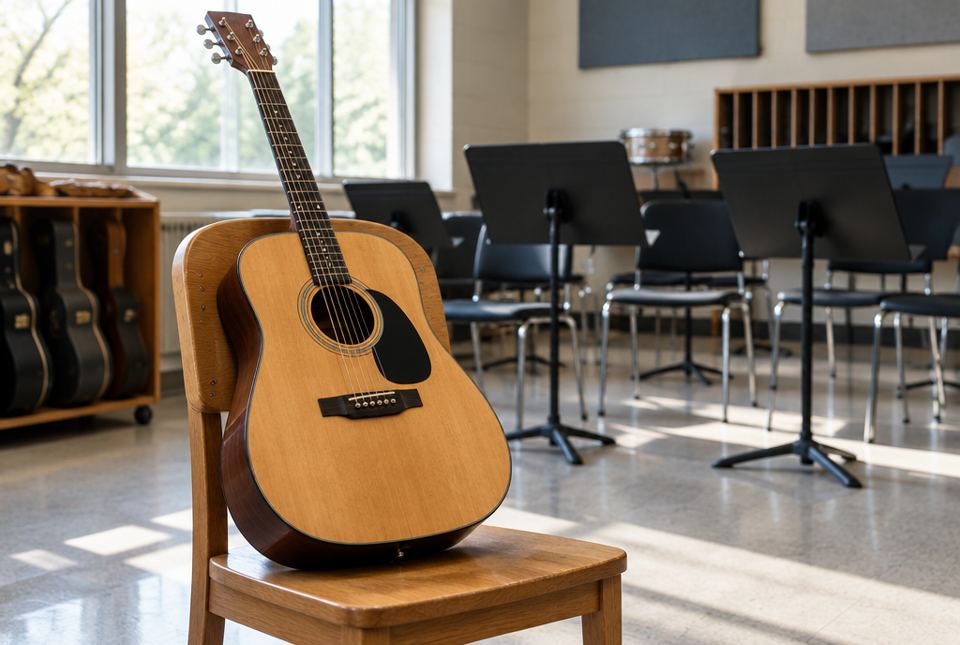 Guitar players strum chords: several notes played together. Many songs use just the I, IV and V chords. AI-generated image
Building a triad
A triad is three notes stacked in 3rds, like a snowman: a bottom, a middle and a top.
- Start on the root (the note the chord is named after).
- Skip one letter to get the 3rd.
- Skip one more letter to get the 5th.
C triad: C, (skip D) E, (skip F) G. On the staff, a triad looks like three notes on three lines in a row, or three spaces in a row.
I, IV and V
We number the notes of the scale with Roman numerals. In C major: C = I, D = II, E = III, F = IV, G = V...
The I, IV and V chords are all major chords in a major key, and together they contain every note of the scale. That's why so many songs, from folk songs to pop, can be played with just these three chords.
- I feels like home: restful and finished.
- IV feels like moving away.
- V feels tense, like it wants to go back home to I.
| Key | I | IV | V |
|---|
| C major | C – E – G | F – A – C | G – B – D |
| G major | G – B – D | C – E – G | D – F♯ – A |
| F major | F – A – C | B♭ – D – F | C – E – G |
| D major | D – F♯ – A | G – B – D | A – C♯ – E |
Chord progressions and the 12-bar blues
A chord progression is a series of chords. A very common one is I – IV – V – I: home, away, tension, home.
The 12-bar blues uses I, IV and V over 12 bars of 4/4. It came from African American musicians in the southern United States and became an important building block of jazz, rock and roll and lots of pop music.
| Bars 1–4 | Bars 5–8 | Bars 9–12 |
|---|
| I | I | I | I | IV | IV | I | I | V | IV | I | I |
Layering sounds: texture
Texture is about layers. A single melody alone is a thin texture. Add a bass line, chords and a drum beat, and the texture becomes thick.
Many musicians today build music with electronic sounds on a computer, tablet or phone. They layer loops (short repeating patterns): first a drum loop, then a bass line playing the chord roots, then chords, then a melody. Free music apps let you do this too.
Worked exampleExample: Let's harmonize a melody with I, IV and V
Choose chords for Twinkle, Twinkle, Little Star in C major. Melody: C C G G | A A G (half) | F F E E | D D C (half).
- Rule: pick a chord that contains the most important melody notes in each bar.
- Bar 1: C C G G. C and G are both in I (C–E–G). Chord: I.
- Bar 2: A A G. A is in IV (F–A–C); G is in I. Chords: IV for "lit-tle", then I for "star".
- Bar 3: F F E E. F is in IV; E is in I. Chords: IV, then I.
- Bar 4: D D C. D is in V (G–B–D); C is in I. Chords: V, then I to end at home.
I | IV I | IV I | V I (in C: C | F C | F C | G C). The song ends with V → I, tension then home.
Worked exampleExample: Let's compose a layered piece for a purpose
Purpose: a 30-second theme for a school podcast about winter sports. Audience: students in Grades 4 to 8. Let's plan it with layers.
- Mood: energetic and cool (like winter air): allegro, a major key.
- Layer 1 (rhythm): a drum loop with a strong beat in 4/4.
- Layer 2 (bass): play the roots of I – IV – V – I in G major: G, C, D, G, one bar each.
- Layer 3 (chords): a bright synthesizer plays the triads G–B–D, C–E–G, D–F♯–A, G–B–D.
- Layer 4 (melody): a short, catchy tune that uses notes from each chord, plus a sparkly electronic sound on top (like snow).
- Form: start with one layer and add one every 2 bars (the texture gets thicker), then drop to just drums and the melody at the end.
A layered piece: drums, bass (roots), chords (I–IV–V–I) and melody, with the texture building up. Every choice (tempo, key, sounds) supports the purpose and audience.
The podcast theme, layer by layer. Adding a layer every 2 bars makes the texture thicker; dropping to drums and melody at the end makes it thin again.Just for funThe I chord walked into a bar. Then the IV chord and the V chord walked in too. Twelve bars later, they had the blues.
Hands-on activityHuman chords and loop layering
You need: two or three people at home, a keyboard app or instrument if you have one, and (optional, with a grown-up's permission) a free music-making app such as GarageBand on Apple devices or BandLab in a web browser.
- Human chords: each person sings one note of the C chord (C, E, G) and holds it together. Then sing the F chord (F, A, C) and the G chord (G, B, D). Use a keyboard app to find the notes. Which chord sounds like home?
- Play or sing the roots of the 12-bar blues in C (C C C C | F F C C | G F C C), four beats per bar.
- Loop layering (optional, using an app): make a 4-bar loop: drums, then a bass line on G–C–D–G, then chords, then a melody. Add one layer at a time and listen to the texture thicken.
- Write down your purpose and audience and explain one choice you made for them.
Your turn
A three-note chord: a root, a 3rd above it and a 5th above it.
3In C major, which notes make the V chord?
4In G major, which notes make the IV chord?
5Which chord feels like home?
6Write the 12-bar blues using Roman numerals.
I I I I | IV IV I I | V IV I I.
7What is texture in music?
How many layers of sound there are and how they fit together.
More practice: warm-up
Three or more notes played at the same time.
2What is the root of a C major triad?
3Which Roman numeral is built on the 5th note of the scale?
4Is a melody alone a thick or thin texture?
A short recorded pattern that repeats over and over.
More practice: on your own
1Build I, IV and V in F major. Which note needs a flat?
I = F–A–C, IV = B♭–D–F, V = C–E–G. The B needs a flat (B♭), as in the key signature.
2Build I, IV and V in D major.
I = D–F♯–A, IV = G–B–D, V = A–C♯–E.
3A melody bar in C major has the notes G, B, D. Which chord fits? Why?
V (G–B–D), because all three melody notes are in that chord.
4Write the 12-bar blues in G major using letter names.
G G G G | C C G G | D C G G.
5Why does a piece usually end with V → I?
V sounds tense and wants to resolve; going to I (home) makes the music sound finished.
Challenge
1Harmonize this C major melody with I, IV or V for each bar, and explain: E G E C | F A F (half) | D B G (half) | C (whole).
Bar 1: E, G, C are in I (C–E–G). Bar 2: F, A are in IV (F–A–C). Bar 3: D, B, G are in V (G–B–D). Bar 4: C is in I. Progression: I | IV | V | I.
2Plan a layered electronic piece for a calm meditation video for families. Describe tempo, key, at least three layers and how the texture changes, linking each choice to the purpose.
Example: adagio, a major key (or minor for a softer, dreamier feel); Layer 1: a soft, long synthesizer pad holding the I chord; Layer 2: a slow bass note on the root changing every 2 bars (I – IV – I – V); Layer 3: gentle bell-like melody with lots of space; texture starts thin (one layer), grows slightly, then thins again so it feels peaceful. No loud drums, since the purpose is calm.
3Explain why I, IV and V together can harmonize so many melodies.
Together, the three triads contain every note of the major scale (I: do mi sol; IV: fa la do; V: sol ti re), so for any melody note there is at least one of the three chords that contains it.
Quiz
1. A triad is made of a root, a ___ and a 5th.
2. In C major, the IV chord is ___.
3. In G major, the V chord is ___.
4. Which chord feels like home?
5. The 12-bar blues uses which chords?
6. Adding more layers of sound makes the texture ___.
Big idea: Students learn the Grade 6 texture/harmony concepts, chord progressions using I, IV and V and layering of electronic sounds, applying them when composing and arranging for a specific effect (C1.2) and for specific purposes and audiences (C1.3), and showing understanding of notation (C1.5) and how elements are used (C2.2).
How to help at home:
- If anyone at home plays guitar, ukulele or piano, play I–IV–V–I and the 12-bar blues together; your child can sing the roots.
- Free music apps are great for layering. Supervise downloads and accounts, and check age rules.
- Ask, "Who is your music for? What should they feel?" before your child composes.
Common difficulties:
- Forgetting sharps or flats in chords (for example D–F–A in G major). Check the key signature.
- Building chords in steps (C–D–E) instead of skips (C–E–G).
- Choosing chords by guessing. Look for the melody notes that are inside each chord.