E. Earth and Space Systems · SpaceThe Moon: Phases, Eclipses and Tides
E2.5 A1.2 A1.4About 50 minutes
Learning goals- I can explain why the Moon seems to change shape (its phases) and name the phases in order.
- I can explain what causes solar and lunar eclipses.
- I can explain how the Moon's gravity causes tides.
- I can follow safety rules for observing an eclipse.
Words to know
phase
The shape of the lit part of the Moon that we see from Earth.
waxing
Growing. The lit part we see is getting bigger each night.
waning
Shrinking. The lit part we see is getting smaller each night.
gibbous
More than half lit, but not full.
solar eclipse
When the Moon passes between the Sun and Earth and blocks some or all of the Sun.
lunar eclipse
When Earth passes between the Sun and the Moon, and Earth's shadow falls on the Moon.
tide
The regular rise and fall of the ocean's surface, caused mostly by the Moon's gravity.
The Moon's changing face
Look at the Moon a few nights in a row. One night it is a thin curved sliver. A week later it is half a circle. Another week later it is a full, round disc. Does the Moon really change shape?
No! The Moon is always a round ball. What changes is how much of its sunlit side we can see from Earth.
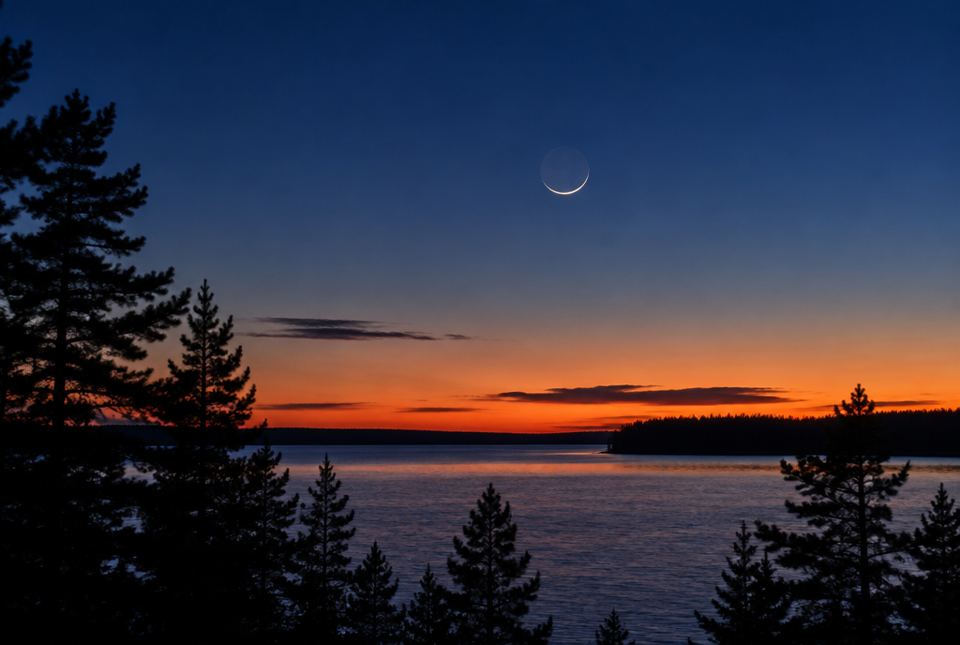 Notice that the lit edge of the crescent points down toward where the Sun has just set. The Sun always lights the side of the Moon that faces it. AI-generated image
Why the Moon has phases
- The Sun always lights up half of the Moon, the half facing the Sun.
- The Moon orbits Earth about once a month.
- As it moves around Earth, we see different amounts of its lit half.
When the Moon is between Earth and the Sun, its lit side faces away from us: we see a new moon (almost nothing). When the Moon is on the far side of Earth from the Sun, we see its whole lit side: a full moon.
It takes about 29.5 days to go from one new moon to the next. That is where the idea of a month comes from.
The Moon also spins exactly once each time it goes around Earth, so the same side of the Moon always faces us.
Waxing or waning?
In Canada, when the right side is lit, the Moon is waxing (growing). When the left side is lit, it is waning (shrinking). "First quarter" looks like a half moon: it means the Moon is a quarter of the way through its orbit.
Eclipses: lining up shadows
An eclipse happens when the Sun, Earth and Moon line up and a shadow falls on Earth or the Moon.
Solar eclipse: the Moon passes between the Sun and Earth. The Moon's shadow falls on part of Earth and blocks the Sun. It can only happen at new moon. On April 8, 2024, a total solar eclipse passed over parts of Ontario, including Hamilton, Niagara Falls and Kingston. The next total solar eclipse in Canada will be in August 2044, in western Canada.
Lunar eclipse: Earth passes between the Sun and the Moon, and Earth's shadow falls on the Moon. It can only happen at full moon. The Moon often turns a coppery red, because a little sunlight bends through Earth's atmosphere onto it. A lunar eclipse happens at night and you are looking at the Moon, not the Sun, so it is safe to watch with just your eyes.
Why not every month? The Moon's orbit is tilted a little (about 5°) compared to Earth's orbit. Most months the Moon passes just above or below the line between the Sun and Earth, so there is no eclipse.
Eclipse safety
Never look directly at the Sun, even during a partial eclipse, and never through binoculars, a telescope, a camera or sunglasses. Sunlight can burn the back of your eye permanently, and it does not hurt while it happens.
The safe way is to project the Sun's image: stand with your back to the Sun and let sunlight pass through a small hole onto a card or the ground. (See the activity.) For special eclipse events, follow the advice of the Canadian Space Agency and an adult.
Tides
The Moon's gravity pulls on Earth's oceans. This makes the water bulge out on the side of Earth facing the Moon (and also on the opposite side). As Earth rotates through these bulges, the ocean rises and falls. Most coasts get two high tides and two low tides about every day.
The Sun's gravity helps too. When the Sun and Moon line up (at new moon and full moon), tides are extra high and extra low.
In Canada, the Bay of Fundy, between New Brunswick and Nova Scotia, has some of the highest tides in the world.
Worked exampleLet's figure out the phase from positions
Tonight the Moon is on the opposite side of Earth from the Sun. What phase is it? Could there be an eclipse tonight? What kind?
- The Sun lights the side of the Moon facing the Sun.
- Earth is between the Sun and the Moon, so from Earth we look at the Moon's whole lit side. This is a full moon.
- If the Sun, Earth and Moon are lined up exactly, Earth's shadow falls on the Moon.
- A shadow from Earth falling on the Moon is a lunar eclipse. A solar eclipse needs a new moon instead.
It is a full moon. Only a lunar eclipse could happen tonight, and only if the three bodies line up exactly.
Just for funWhy did the Moon say no to dessert?
Because it was already full! 🌕
Hands-on activityMoon phases model and pinhole projector
You need: a lamp with the shade removed (or a strong flashlight on a table), a ball about the size of an orange stuck on a pencil (or a foam ball on a stick), a dark room; also two pieces of white cardboard, a thumbtack or sharp pencil, and a grown-up helper.
Part A: Phases (A1.2)
- Put the lamp at one side of the room at about head height. You are Earth. Hold the ball at arm's length, a little above your head.
- Face the lamp with the ball in front of you: you see the dark side (new moon).
- Slowly turn on the spot to your left (counterclockwise), keeping the ball in front of your face. Watch the lit part grow: crescent, quarter, gibbous, and full when your back is to the lamp (hold the ball a bit higher so your head's shadow doesn't cover it).
- Keep turning to see it shrink again. Draw each phase you see.
Part B: Pinhole projector (for watching the Sun safely)
- With a grown-up, poke a small, neat hole in the middle of one card.
- Outdoors, stand with your back to the Sun. Hold the card with the hole up over your shoulder and the second card about 1 m below it in its shadow.
- A small round image of the Sun appears on the lower card. During a partial solar eclipse, it would look like a bite has been taken out of it.
What to look for: in Part A, the ball goes through all eight phases in the same order as the real Moon. If your head blocks the light at "full", you have made a model lunar eclipse! In Part B, you see the Sun's image without looking at the Sun.
Safety (A1.4): a bare light bulb gets hot: do not touch it, and keep paper away from it. Let a grown-up make the hole with the pin. Never look at the Sun or through the pinhole at the Sun; look only at the image on the lower card.
Your turn
1Why does the Moon seem to change shape?
As the Moon orbits Earth, we see different amounts of its sunlit half.
2About how long is it from one full moon to the next?
Growing: we see more of the lit part each night.
4What lines up during a solar eclipse?
The Moon is between the Sun and Earth.
5At which phase can a lunar eclipse happen?
Mostly the Moon's gravity pulling on Earth's oceans (the Sun's gravity helps too).
7What is the safe way to watch a solar eclipse at home?
Project the Sun's image with a pinhole projector while standing with your back to the Sun. Never look at the Sun.
More practice: warm-up
1What phase comes right after new moon?
2What phase comes right after full moon?
3Which phase looks like a half circle with the right side lit?
4Is it safe to look at the Sun through sunglasses?
5Name a place in Canada with very high tides.
More practice: on your own
1Why don't we have a solar eclipse at every new moon?
The Moon's orbit is tilted (about 5°), so most months the Moon passes above or below the line between the Sun and Earth, and its shadow misses Earth.
2Why does the Moon look reddish during a total lunar eclipse?
A little sunlight bends through Earth's atmosphere and reaches the Moon. The light that gets through is mostly red, so the Moon looks coppery red.
3Tonight the left half of the Moon is lit. Is it waxing or waning? What will it look like in about a week?
Waning (it is the last quarter). In about a week it will reach new moon, so we will see almost none of it.
4Why do we always see the same side of the Moon?
The Moon spins once in the same time it takes to orbit Earth once, so the same side always faces us.
5Why does a solar eclipse only happen at new moon?
The Moon must be between the Sun and Earth to block the Sun. That is exactly where it is at new moon.
Challenge
1An eclipse of the Sun can be seen only from a narrow strip of Earth, but a lunar eclipse can be seen from the whole night side of Earth. Explain why.
In a solar eclipse, the Moon's shadow is small compared to Earth, so it covers only a small area. In a lunar eclipse, the Moon is inside Earth's large shadow, so anyone who can see the Moon (the whole night side) sees the eclipse.
2Why are tides extra high at full moon and new moon?
At those times, the Sun, Earth and Moon line up, so the Sun's gravity and the Moon's gravity pull together on the oceans, making bigger bulges.
3In the lamp model, Leo's head kept blocking the light when he tried to show a full moon. What real event was he accidentally modelling? What could he change to show a normal full moon?
A lunar eclipse (Earth's shadow on the Moon). He could hold the ball a little higher (above the shadow of his head), like the real Moon passing above or below Earth's shadow because its orbit is tilted.
Quiz
1. Why does the Moon have phases?
2. Which phase comes after first quarter?
4. A lunar eclipse can only happen at...
5. What is the main cause of ocean tides?
6. Which is a safe way to watch a partial solar eclipse?
7. On April 8, 2024, people in Kingston, Ontario, saw...
Big idea (E2.5): describe effects of the relative positions and motions of Earth, the Moon and the Sun: phases, eclipses and tides. The lamp model practises investigation (A1.2) and the projector practises safety (A1.4).
How to help: keep a Moon diary together for a month: each clear evening, draw the Moon and note the date. Check that phases come in the order shown. If you visit the ocean, look up a tide table.
Common difficulties:
- Thinking phases are caused by Earth's shadow. This is very common. Earth's shadow only falls on the Moon during a lunar eclipse.
- Mixing up solar and lunar eclipses. Solar = the Sun is hidden (Moon in the middle). Lunar = the Moon is darkened (Earth in the middle).
- Thinking the Moon is only out at night. The Moon is often visible in the daytime.
Safety: never let your child look at the Sun directly or through binoculars, a telescope, a camera or sunglasses. Supervise the pinhole and the bare bulb.
Sources: eclipse locations and the 2044 date: CTV News Ottawa, citing the Canadian Space Agency. Lunar cycle (29.5 days) and orbit tilt (about 5°): NASA.