B. Number · Number Sense: Numbers to One Million, Integers, Decimals and FractionsComparing, Ordering and Using Big Numbers
B1.1 B1.3 A1About 40 minutes
Learning goals- I can compare two whole numbers up to one million using >, < and =.
- I can put whole numbers to one million in order.
- I can place big numbers on a number line.
- I can describe ways that big numbers are used in everyday life.
Words to know
greater than (>)
Bigger. 520 000 > 502 000.
less than (<)
Smaller. 98 500 < 120 000.
ascending order
From least to greatest.
descending order
From greatest to least.
Remember from Grade 5
In Grade 5 you compared numbers to 100 000 by lining up the places and checking digits from the left. The same steps work for numbers up to one million.
Which concert had more people?
A music festival in a Canadian city ran for two summers. The organizers counted:
- Summer 1: 158 760 visitors
- Summer 2: 185 670 visitors
The numbers use the same digits! Which summer had more visitors?
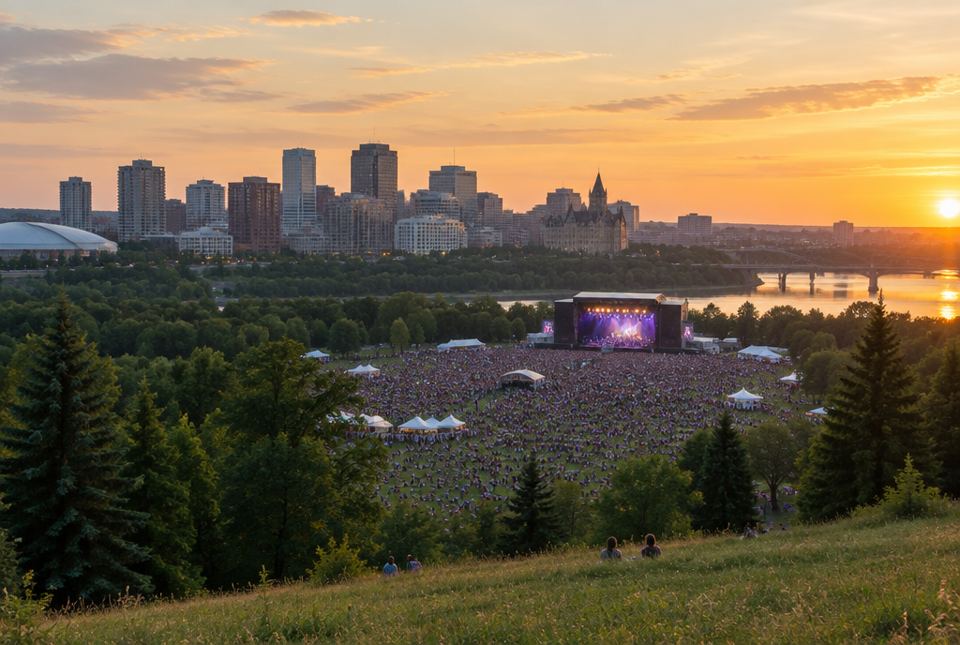 A big festival can draw well over one hundred thousand visitors in a summer. To compare totals like 158 760 and 185 670, line up the places and compare from the left. AI-generated image
Steps to compare whole numbers
- Count the digits. More digits means a greater number (when there are no extra zeros at the front). 100 000 has 6 digits, so it is greater than any 5-digit number.
- If they have the same number of digits, line up the places and compare from the left.
- The first place where the digits are different decides.
For the festival: 158 760 and 185 670. The hundred thousands are the same (1). In the ten thousands, 5 < 8. So 158 760 < 185 670. Summer 2 had more visitors.
| Hundred thousands | Ten thousands | Thousands | Hundreds | Tens | Ones |
|---|
| Summer 1 | 1 | 5 | 8 | 7 | 6 | 0 |
| Summer 2 | 1 | 8 | 5 | 6 | 7 | 0 |
Worked exampleExample 1: Order a list
Put these numbers in ascending order (least to greatest): 96 400, 609 400, 690 040, 604 900
- Count digits: 96 400 has only 5 digits, so it is the least.
- The others all start with 6 in the hundred thousands. Compare ten thousands: 609 400 and 604 900 have 0; 690 040 has 9, so it is the greatest.
- Compare 609 400 and 604 900 at the thousands: 4 < 9, so 604 900 < 609 400.
96 400, 604 900, 609 400, 690 040
Worked exampleExample 2: How big numbers are used
Here are four big numbers from everyday life. What is each one doing?
- A car's odometer reads 187 432 km.
- A house is for sale for $649 900.
- A school's reading total is 386 492 minutes.
- A charity's phone number is 1 800 ### ####.
- The odometer measures a distance.
- The price is an amount of money (it measures value).
- The reading total counts minutes.
- The phone number is a label or code. It is not an amount, so we don't compare or add phone numbers.
Big numbers can count, measure (length, mass, time, money) or label. Knowing which helps you decide what makes sense to do with the number.
Big numbers can count, measure or label. It makes sense to compare or add the first three kinds, but never phone numbers!Big numbers in the news
News stories often round big numbers so they are easy to understand. A headline might say "About 160 000 people came to the festival" instead of "158 760 people". The exact number is still useful for organizers, who need to know how many tickets were sold.
Be a good math partner
When you and a partner disagree about which number is greater, don't just argue. Each of you show your thinking with a place value chart or a number line. Then decide together. Good mathematicians listen to each other's reasons.
Just for funPhone numbers are big numbers you should never add. If you added the phone numbers of two pizza places, you'd get a number that answers... nobody. And no pizza.
Hands-on activityGreatest number wins
You need: a deck of playing cards with the 10s and face cards (J, Q, K) removed. Aces count as 1. Use a paper scrap marked "0" as a joker that counts as zero (or write 0 to 9 on paper scraps).
- Each player draws a 6-box place value chart: hundred thousands to ones.
- Take turns flipping one card. Each player must write that digit in one of their empty boxes. Once a digit is placed, it can't move!
- After six cards, read your numbers aloud. The greatest number wins the round. Write the comparison with > or <.
- Play again, but this time the least number wins (a 0 in the hundred thousands box is not allowed).
Math talk: Where did you put a big digit like 9? Why? Shake hands at the end: win or lose, a good sport says "Good game!"
Your turn
1Use >, < or =: 430 900 ___ 439 000
<. The thousands digits are 0 and 9, and 0 < 9.
2Use >, < or =: 99 999 ___ 100 000
<. 99 999 has 5 digits; 100 000 has 6.
3Use >, < or =: 705 200 ___ 702 500
4Order from least to greatest: 512 000, 215 000, 521 000
215 000, 512 000, 521 000
5Order from greatest to least: 88 450, 880 450, 808 450
6Is a postal code or a bus route number used to count, measure or label?
To label. It names a place or a route; it is not an amount.
7Between which two hundred thousands does 648 300 sit on a number line?
Between 600 000 and 700 000 (a little closer to 600 000).
More practice: warm-up
1Use >, < or =: 300 000 ___ 30 000
2Use >, < or =: 450 120 ___ 450 120
3Which is greater: 610 000 or 601 000?
4Order from least to greatest: 1 000 000, 100 000, 10 000
10 000, 100 000, 1 000 000
5Does a car's odometer reading count, measure or label?
More practice: on your own
1Use >, < or =: 263 489 ___ 263 498
<. The first different place is the tens: 8 < 9.
2Order from least to greatest: 73 950, 739 500, 730 950, 79 350
73 950, 79 350, 730 950, 739 500. The 5-digit numbers come first; then compare place by place.
3Write a number that is between 499 990 and 500 010.
For example 500 000 (any number from 499 991 to 500 009 is correct).
4Two towns have 84 607 and 84 670 people. A news story says "Both towns have about 85 000 people." Is that reasonable? Which town is bigger?
Yes, both round to about 85 000. The town with 84 670 is bigger (tens: 7 > 0).
5Write the greatest six-digit number that has the digits 4, 4, 0, 0, 7, 7.
774 400. Put the biggest digits in the biggest places.
Challenge
1Fill in a digit to make this true. How many answers are there? 52_ 300 > 527 900
The digit can be 8 or 9 (528 300 and 529 300). If it were 7, 527 300 < 527 900. 2 answers.
2A number line goes from 0 to 1 000 000. Mark A is exactly halfway between 0 and 1 000 000. Mark B is halfway between A and 1 000 000. What numbers are A and B?
A = 500 000. B = 750 000 (halfway between 500 000 and 1 000 000).
3A video's view counter reads 998 750. If it gets 1300 more views, will it pass one million? Explain.
Yes, just barely. 998 750 + 1250 = 1 000 000, and 1300 is 50 more than 1250, so it will show 1 000 050.
Quiz
2. Which list is in order from least to greatest?
3. Which place decides: 671 254 or 671 524?
4. A house price of $489 000 is a number that...
5. Which number is closest to 500 000 on a number line?
6. Which number is the greatest?
Big idea: Grade 6 students compare and order whole numbers to one million and describe how big numbers are used in daily life (B1.1). Expectation B1.3 asks them to compare and order integers, decimals and fractions; whole numbers are where that starts.
Common difficulties:
- Comparing first digits only. 96 400 vs 604 900: some children see 9 > 6 and say 96 400 is bigger. Always count the digits first.
- Same digits, different order. 158 760 vs 185 670: line the numbers up in a chart.
- Counting vs labelling. Phone numbers and postal codes look like numbers but aren't amounts.
How to help: Play "Greatest number wins" with a deck of cards. Talk about strategy ("Why did you put the 2 in the ones place?") and model good sportsmanship, which supports the social-emotional skills in Strand A.