A. Literacy Connections and Applications / C. Comprehension: Understanding and Responding to Texts · Understanding and Responding to TextsComparing Genres and Cultural Text Forms, and Reading for a Purpose
C1.2 C2.2 A3.1About 40 minutes
Learning goals- I can analyze and compare the characteristics of genres such as fantasy, science fiction, news report, speech and spoken word poetry.
- I can explain how a genre's characteristics help it communicate meaning.
- I can describe cultural text forms, such as the ghazal and spoken word poetry, and explain how their features share meaning.
- I can name purposes for reading, choose texts by diverse creators that fit my purpose, and explain my choice.
- I can explain how knowing genres helps me in other subjects and in daily life.
Words to know
genre
A family of texts that share characteristics, such as fantasy, science fiction or news report.
fantasy
Fiction with magic or impossible events that could never happen in our world.
science fiction
Fiction built on science or technology that does not exist yet, but might someday.
news report
A factual text about a recent event that answers who, what, when, where, why and how, with the most important facts first.
speech
A text written to be spoken to an audience, often to inform, persuade or celebrate.
spoken word poetry
Poetry written to be performed aloud, using rhythm, repetition and the poet's voice and body.
ghazal
A poetry form of linked couplets in which the second line of each couplet ends with the same repeated word or phrase. It comes from Arabic poetry and grew in Persian and Urdu poetry.
couplet
Two lines of poetry that go together.
Remember from Grade 5
In Grade 5 you described genres such as myth, legend, memoir, biography, editorial and free verse, and cultural text forms such as Anansi stories and tanka. You chose texts by diverse creators for a purpose.
In Grade 6 you will go one step further: you will analyze and compare genres side by side, explain exactly how their features create meaning, and meet two more cultural text forms.
Hook: Six texts about the northern lights
All six short texts below are about the northern lights (the aurora borealis). They were written for this website. As you read, ask: What kind of text is this? Which clues tell me? What is it trying to do to me as a reader?
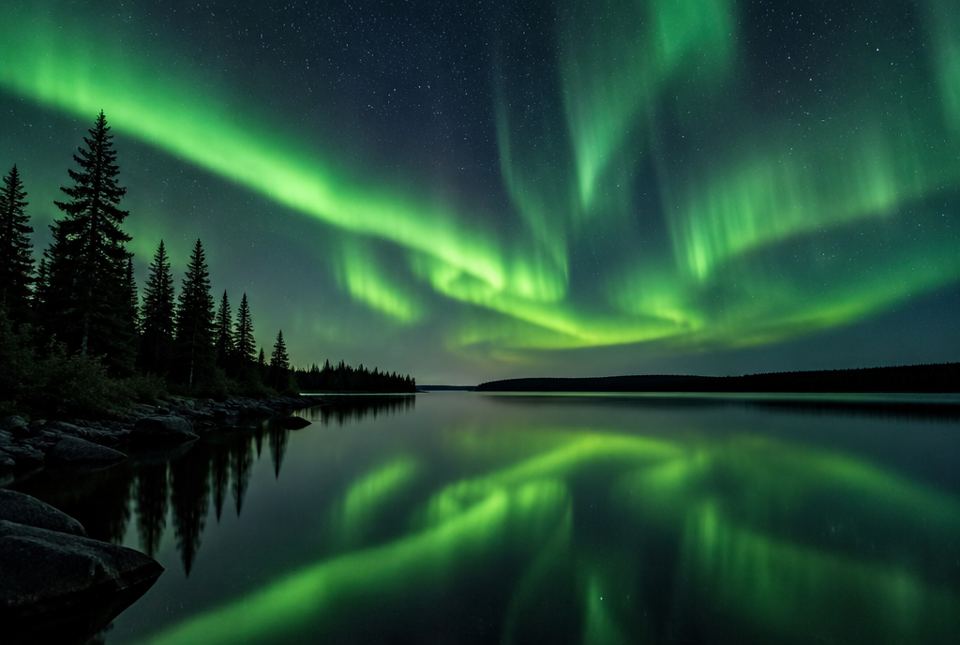 The northern lights over a northern lake. As you read the six texts, notice how each genre describes this same sight in a different way and for a different purpose. AI-generated image
Text A: The Sky Weaver
Every winter night, the Sky Weaver climbed the tallest spruce on the ridge and spun her loom of starlight. Mira watched from her frosted window as green threads unrolled across the dark. "Teach me," Mira whispered. To her astonishment, a single glowing thread drifted down and wrapped around her finger, warm as a mitten.
Text B: Station Aurora
In the year 2091, the research station orbited 400 kilometres above Nunavik. Dr. Amara Osei tapped her wrist screen, and the solar-wind sensor flashed red. "A storm is coming," she told the crew. "Shields up in ten minutes." Below them, the northern lights rippled like a curtain, and the station's new particle catcher hummed as it began to collect the Sun's energy.
Text C: Northern Lights Dazzle Pine Hollow
PINE HOLLOW — Hundreds of residents stood on frozen driveways on Tuesday night to watch bright green and pink northern lights dance over the town.
The aurora appeared at about 10 p.m. and lasted nearly two hours. "I've lived here 40 years and never seen it this bright," said resident Gloria Martin.
Northern lights happen when tiny charged particles from the Sun crash into gases high in Earth's atmosphere, making them glow. (This news report and the town are made up for this lesson. The science is real.)
Text D: from a speech at the Pine Hollow Library Astronomy Night
Good evening, everyone, and thank you for coming out on such a cold night! Tonight, I want to ask you one question: When did you last look up? Our town has some of the darkest skies in the region. Our children have seen the northern lights from their own backyards. Let's protect that. Let's keep our skies dark, and let's keep looking up!
Text E: Patience (a ghazal)
The cold bites our cheeks as we wait on the hill for the sky. Grandpa says patience is a gift that we give to the sky.
A ribbon of green unrolls, slow as a cat waking up. We forget our frozen toes and lend our eyes to the sky.
At home my sister sleeps; I will tell her at breakfast how the whole hill held its breath and listened to the sky.
Text F: Look Up (spoken word, meant to be performed)
Look up. No, really. Put the phone down. Look up. Because the sky is doing something that no screen can do, it's painting in green, it's painting in pink, it's painting for me, and it's painting for you. So look up.
Comparing the genres
- Text A is fantasy. A magical being (the Sky Weaver) and an impossible event (a thread of light drifts down) make it fantasy. Fantasy helps readers feel wonder.
- Text B is science fiction. It is set in the future (2091) with technology that does not exist yet (a particle catcher). It builds on real science (solar wind causes auroras). Science fiction makes readers ask What if?
- Text C is a news report. It has a headline, a dateline (PINE HOLLOW —), answers who, what, when, where, why in the first paragraphs, and uses a quotation from a witness. It uses facts, not opinions, to inform.
- Text D is a speech. It greets the audience (Good evening, everyone), asks a question, uses we/our/let's to include listeners, and ends with a memorable call to action (keep looking up!). Speeches are written for the ear.
- Text E is a ghazal. It is made of couplets, and each couplet ends with the same refrain (the sky). The repetition makes the poem feel like a circle you keep coming back to.
- Text F is spoken word poetry. It talks directly to the listener, uses short lines, repetition (Look up, it's painting) and rhyme (do/you) so it sounds powerful performed aloud.
| Fantasy (A) | Science fiction (B) |
|---|
| Setting | A magical version of our world, any time | Often the future or space |
| What makes it 'impossible'? | Magic and magical beings | Technology or science that doesn't exist yet |
| Could it ever happen? | No, it breaks the rules of nature | Maybe someday; it follows scientific ideas |
| Effect on the reader | Wonder, imagination | Asks What if? about science and the future |
Worked exampleLet's compare a news report and a speech
Texts C and D are both non-fiction about the northern lights in Pine Hollow. How are their characteristics different, and how does each characteristic help it communicate?
- Purpose: The news report wants to inform. The speech wants to persuade people to protect dark skies.
- Point of view: The report is in third person and neutral (it does not say what we should do). The speech uses we, our, let's.
- Organization: The report puts the most important facts first (an inverted pyramid), so readers who stop early still get the main news. The speech builds up to its call to action at the end, so listeners remember it.
- Language: The report uses facts and a quotation as evidence. The speech uses a question and repetition (Let's... let's...), which are easy to remember when you only hear a text.
The news report informs with neutral facts, most important first. The speech persuades with we language, questions and repetition, building to a call to action. Each set of features fits its purpose and how its audience receives it (reading vs. listening).
Cultural text forms
Cultural text forms come from a particular culture's ways of sharing ideas.
- The ghazal (say GUZZ-ul) comes from Arabic poetry and became especially loved in Persian and Urdu poetry. Famous ghazal poets include Hafez, who wrote in Persian, and Ghalib, who wrote in Urdu. A ghazal is made of couplets. Each couplet can stand on its own, but they are linked by a refrain, a word or phrase repeated at the end of the second line of each couplet. Ghazals often express longing or love. Today, poets write ghazals in many languages, including English.
- Spoken word poetry is written to be performed. It grows from very old traditions of sharing poetry aloud, and it is also closely connected to hip-hop and to poetry slams in many communities. The poet's voice, pauses, rhythm and gestures are part of the meaning, so reading it silently is only half the experience.
The features of each form match its purpose: the ghazal's refrain lets a feeling return again and again, and spoken word's repetition and rhythm help a listening audience follow and feel the message.
Choosing texts for a purpose
Good readers start with Why am I reading? and then choose texts that fit. In Grade 6, explain your choice with two reasons: what the genre offers, and what the creator offers.
For example:
- To understand a historical event: a non-fiction history book for facts, plus historical fiction or a memoir to feel what it was like.
- To learn how something works for science: a report with diagrams, or a reliable science website.
- To make up my mind on an issue: editorials and speeches from different sides, plus a neutral news report.
- To enjoy and imagine: fantasy, science fiction, mysteries, graphic novels.
- To understand a community's experience: texts by creators from that community.
Choosing creators from diverse backgrounds (cultures, languages, abilities, ages, places) gives you more perspectives and a truer picture of the world.
Worked exampleLet's choose texts and explain why they fit
Jaspreet's purpose: For a social studies project, I want to understand what life is like for kids in a fly-in First Nations community in northern Ontario. Which texts fit best, and why?
- A fantasy novel about a dragon
- A news report from a First Nations-run news service about a new school opening in a northern community
- A blog by a teacher from southern Ontario who visited a northern community for one week
- A video made by students in a northern First Nation school about their daily lives
- Jaspreet needs real information about daily life, so the fantasy novel (1) does not fit.
- Text 2 is a news report (facts) from a First Nations-run news service, so it is factual and told from the community's own perspective.
- Text 4 is made by students who live there, so it shows their lived experience in their own voices.
- Text 3 could be interesting, but the writer is an outsider who stayed one week. It could be used, but Jaspreet should compare it with texts by community members.
Texts 2 and 4 fit best. The genres give real, current information, and the creators are community members who know the experience from the inside. Text 3 is a weaker, outside perspective.
Genre mash-upWhat do you get if you cross a news report with a fantasy?
BREAKING: Local Sky Weaver drops glowing thread. Witness says it was "warm as a mitten." More at 11.
Genre skills in every subject
In science, knowing that a report has subheadings and diagrams helps you find facts fast. In social studies, knowing that historical fiction mixes invented characters with real events helps you separate fact from imagination. In math, word problems are their own genre: you read them slowly, twice. In daily life, recognizing a speech or an ad tells you someone is trying to persuade you.
Hands-on activityGenre detectives and a performance
You need: 6 to 8 texts from home or the library (novels, a newspaper or news website a grown-up opens, a cookbook, a magazine, a poetry book), sticky notes, a pencil.
- On a sticky note for each text, write the genre and two characteristics that prove it.
- Choose two texts in genres that are easy to mix up (fantasy and science fiction, news report and editorial, memoir and biography). Make a 3-column chart comparing them: feature, text 1, text 2.
- Perform Text F, Look Up, for your family: try it once in a flat voice, then again with pauses, a louder Look up and a gesture. Ask: Which performance made the message stronger? Why?
- Write one couplet of your own ghazal about your favourite place, ending with a refrain like by the lake or in the snow.
- Pick a purpose (for example, learn about life in another country) and find two texts by creators from different backgrounds that fit. Explain your choice in two sentences.
Your turn
1Is Text B, Station Aurora, fantasy or science fiction? Give two pieces of evidence.
Science fiction. It is set in the future (2091), and it uses technology that doesn't exist yet but is based on real science (a particle catcher collecting solar energy; solar-wind sensors).
2What makes Text A fantasy instead of science fiction?
It has magic: a magical being, the Sky Weaver, weaves starlight, and a thread of light floats down to Mira. It is not explained by science; it could never happen.
3Name three features of a news report that appear in Text C.
Any three: a headline, a dateline (PINE HOLLOW —), the 5 Ws in the first paragraph, a quotation from a witness, facts with no opinion, the most important facts first.
4Find two features in Text D that show it is written to be heard.
Any two: it greets the audience (Good evening, everyone), asks a question (When did you last look up?), uses repetition (Let's... let's...), and ends with a short, memorable call to action.
5What is the refrain in the ghazal Patience?
the sky. It ends each couplet (and both lines of the first couplet).
6Why does spoken word poetry use a lot of repetition?
Listeners can't reread, so repetition helps them follow and remember the message, and it creates rhythm when performed.
7Your purpose: decide whether our town should turn off streetlights after midnight. Which two kinds of text would you choose?
Opinion texts from both sides (for example, speeches or editorials for and against) and a neutral news report with facts. Reading several perspectives helps you make a fair decision.
More practice: warm-up
1Which genre is set in the future with new technology?
2Which genre uses magic and impossible events?
Two lines of poetry that go together.
4Is a news report mostly facts or mostly opinions?
5Is spoken word poetry meant to be read silently or performed aloud?
More practice: on your own
1Why does a news report put the most important facts first?
Many readers only read the beginning, so putting the key facts first means they still get the main news. The details can come later.
2How is the ghazal's refrain like a chorus in a song?
Both repeat at regular places, tying the parts together and bringing the listener back to the main feeling each time.
3A text begins Ladies and gentlemen, students and staff... Which genre is it? How do you know?
A speech: it greets a live audience directly, which a written report or story would not do.
4Why might a reader choose historical fiction and a non-fiction history book about the same event?
The non-fiction book gives facts, and the historical fiction helps you imagine and feel what it was like for a person living then. Together they give a fuller understanding.
5Why should you check who created a text when your purpose is to learn about a community?
Creators from the community share lived experience and are more likely to be accurate and respectful; outsiders may misunderstand or repeat stereotypes.
Challenge
1Rewrite the first sentence of Text A, The Sky Weaver, so it becomes science fiction instead of fantasy. Explain what you changed.
Example: Every winter night, the weather robot SKY-9 climbed the tallest spruce on the ridge and scanned the solar wind. I replaced the magical being with future technology based on science, which turns fantasy into science fiction.
2Compare Text E (ghazal) and Text F (spoken word). Give one way they are alike and two ways they are different.
Alike: both use repetition (the sky / Look up). Different: the ghazal is built from couplets with a refrain at the end of each, and has a quiet, reflective mood; spoken word speaks directly to the listener (Put the phone down), uses short lines and rhyme, and has an urgent, energetic tone meant for performance.
3Write a two-sentence explanation for a younger student: Why should I read books by creators from many different backgrounds?
Example: Every person sees the world from where they stand. Reading books by many different kinds of people lets you see more of the world and understand people better. (Look for a clear reason in simple words.)
Quiz
1. In the year 2150, Lena's robot dog warned her that the ocean city's air supply was failing. This is most likely...
2. Which feature belongs to a news report?
4. Why do speeches often use repetition and questions?
5. Your purpose is to understand what it was like to arrive in Canada as a refugee. Which text fits best?
6. Which is the best evidence that a story is fantasy rather than science fiction?
What this lesson teaches: Grade 6 students analyze and compare the characteristics of various text forms and genres, including cultural text forms, and explain how those characteristics help communicate meaning (C1.2). They identify purposes for reading and select texts by diverse creators, explaining why the texts fit (C2.2), and explain how literacy supports other subjects and daily life (A3.1).
How to help at home:
- When your child chooses a book, ask: "What genre is it? What clues tell you?" Then: "What would change if it were a different genre?"
- Watch or listen to a spoken word performance together (many poets share them online; preview first) and talk about how voice and pauses change meaning.
- Before a school project, ask: "What's your purpose? Who would know about this from the inside?"
Common difficulties:
- Fantasy vs. science fiction. Ask: "Is it magic (fantasy) or future science and technology (science fiction)?"
- Listing features without explaining them. Push for the second half: "How does that feature help the reader?"
- Choosing a text only because it's easy to find. Encourage checking who made it.
About the texts: All six passages were written for this site; Pine Hollow is a made-up town. The science in Text C (charged particles from the Sun making gases in the upper atmosphere glow) is accurate. The ghazal comes from Arabic poetry and flourished in Persian and Urdu; Hafez and Ghalib are famous ghazal poets.