B. Active Living / C. Movement Competence · Active Living and Movement: Fit, Safe and Game SmartFuel My Fire: Motivation and Being Active for Life
B1 A1.3 A1.5 A1.6About 35 minutes
Learning goals- I can explain the difference between intrinsic and extrinsic motivation, with examples from my own life.
- I can describe how confidence, enjoyment and the people around me affect how active I am.
- I can find activities at home, at school and in my community that I could enjoy for life.
- I can use an activity log to make a plan that turns activity into a habit.
Words to know
motivation
The reasons that make you want to do something.
intrinsic motivation
Wanting to do something because of what happens inside you: it is fun, interesting, or makes you feel good or proud.
extrinsic motivation
Wanting to do something because of something outside you: a prize, a medal, praise, a grade or someone telling you to.
confidence
Believing you can do something, or that you can learn to.
habit
Something you do so regularly that it becomes part of your routine without much thinking.
lifelong activity
An activity you could keep enjoying as a teen and an adult, like walking, biking, swimming, dancing or paddling.
active transportation
Getting places using your own energy: walking, biking, scootering, or rolling in a wheelchair.
Remember from earlier grades
In Grade 4 you sorted reasons to be active into inside reasons and outside reasons, and you found ways around barriers. In Grade 5 you discovered what makes activity fun for you and checked your whole day against Sweat, Step, Sleep, Sit (at least 60 minutes of moderate to vigorous activity a day).
This year you will learn the grown-up names for those reasons, intrinsic and extrinsic motivation, and why one kind usually lasts longer. You will also look at confidence, habits, and activities you could enjoy for the rest of your life.
Two kids, one hockey season
Maya and Leo both join a house-league hockey team in November.
- Leo joins because his parents promised him a new video game if he finishes the season.
- Maya joins because she loves the feeling of gliding on the ice and wants to get better at passing.
In February, it is minus 20 outside and practice is at 7 a.m. Who do you think is more likely to still be excited to go?
Most people guess Maya. Her reasons come from inside her, so they don't disappear when the reward is far away or the weather is cold.
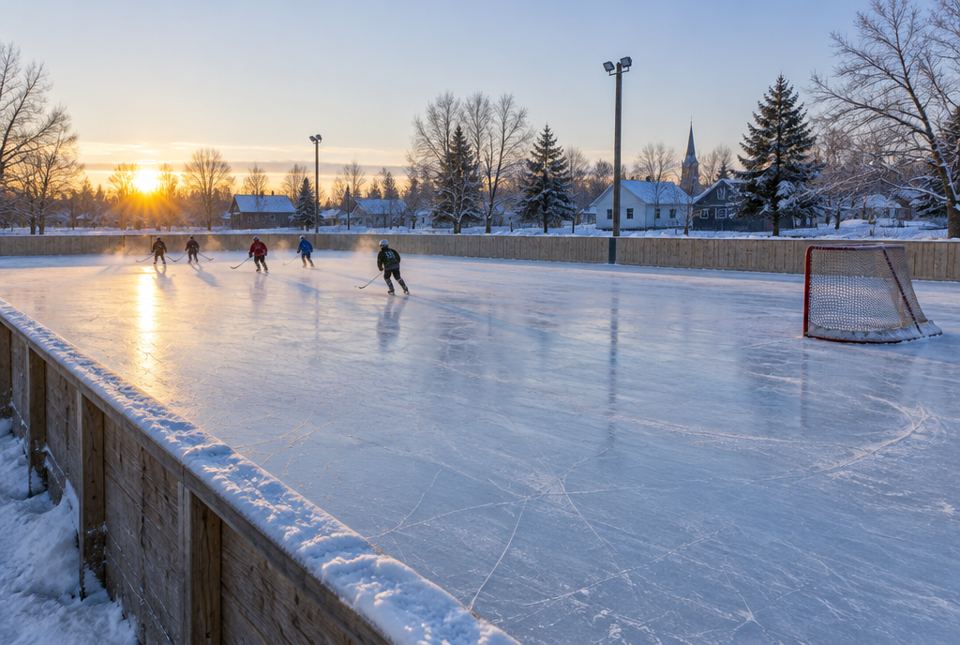 An early-morning outdoor rink on a cold winter day. Think about Maya and Leo: what kind of motivation gets someone out here at 7 a.m. when it is minus 20? AI-generated image
Intrinsic and extrinsic motivation
- Intrinsic motivation comes from inside you. You do the activity because it is fun, interesting, challenging in a good way, or makes you feel good or proud.
- Extrinsic motivation comes from outside you. You do the activity for a reward (a prize, a ribbon, a sticker), for praise, for a mark, or because someone tells you to.
Both kinds are real, and both can help. A ribbon at a track meet can get you started. But research on motivation suggests that people who enjoy an activity for its own sake tend to keep doing it longer.
A good plan: use extrinsic motivation to get started, then look for the intrinsic reasons that will keep you going.
| Reason | Intrinsic or extrinsic? | Why |
|---|
| "Skipping to music makes me feel happy." | Intrinsic | The good feeling comes from inside you. |
| "I'll get a badge if I swim 10 lengths." | Extrinsic | The badge is an outside reward. |
| "I want to see if I can beat my own best time." | Intrinsic | The challenge itself is the reason. |
| "My coach said I have to come to practice." | Extrinsic | Someone outside you is the reason. |
| "Biking in the woods helps me feel calm." | Intrinsic | The calm feeling is inside you. |
| "I want my friends to think I'm cool." | Extrinsic | It depends on what other people think. |
Confidence: "I can learn this"
One of the biggest things that affects whether people stay active is confidence: believing you can do something, or that you can learn to.
Confidence grows when you:
- practise a skill in small steps and notice yourself improving,
- compare yourself with yourself, not with the best player in the class,
- hear encouraging words from others and from yourself,
- see someone like you do it (a friend, a family member, an athlete you admire).
Your self-talk matters too. "I'm terrible at this" makes you want to quit. "I'm not there yet, but I'm getting better" keeps you going. That is called a growth mindset.
Activities for life
Team sports are great, but many adults don't play on teams. The activities people often keep doing for life are ones they can do in many places, at any age, with friends or alone, without much cost.
Examples: walking and hiking, biking, swimming, dancing, skating, cross-country skiing, snowshoeing, paddling a canoe or kayak, yoga, gardening, and pickup games at the park.
Your community probably has places to try them: trails, parks, outdoor rinks, community centres, pools and libraries (some lend out sports equipment). Many First Nations, Métis and Inuit communities across Canada hold land-based and traditional activities, and the North American Indigenous Games bring together Indigenous athletes from across North America in many sports, including lacrosse and canoe/kayak.
From "I should" to "I just do": building a habit
A habit is something you do so regularly that you don't have to decide every time. Brushing your teeth is a habit. Being active can be one too.
Habit helpers:
- Same time, same place. "Every day after school, I shoot baskets for 15 minutes."
- Make it easy. Leave your skipping rope by the door. Lay out your running shoes.
- Link it to something you already do. "After supper dishes, our family walks around the block."
- Make it fun. Music, a friend, a new route, a challenge.
- Track it. A check mark on a calendar each day feels great, and helps you notice patterns.
- Use active transportation. Walking, biking or rolling to school or a friend's house adds active minutes without any extra time.
Reframe it: find your inside reason
When you catch yourself saying "I have to go to practice," try finding an inside reason: "I get to see my friends and work on my wrist shot."
This is called reframing: looking at the same thing in a new way. It doesn't mean pretending everything is fun. It means looking for the part that matters to you.
Worked exampleLet's sort the reasons in a log
Sam kept this note for a week: Mon: walked dog 20 min (my job). Tue: soccer practice 60 min (I love scoring). Wed: nothing, rained. Thu: biked to Jay's 15 min, played tag 30 min (so fun). Fri: gym class fitness test 40 min (for my mark). Sat: skating 45 min with cousins (we laughed the whole time). Sun: nothing, too tired. What can Sam learn?
- Add the minutes: 20 + 60 + 0 + 45 + 40 + 45 + 0 = 210 minutes in the week. (Thursday: 15 + 30 = 45.)
- Compare with the guideline: 60 minutes a day × 7 days = 420 minutes. Sam's log shows about half. (School activity like DPA and recess might not be in the log, so Sam could add those too.)
- Sort the reasons: Intrinsic: soccer (love scoring), tag (fun), skating (laughing with cousins). Extrinsic: walking the dog (a job), fitness test (for a mark).
- Spot the barriers: Wednesday (rain) and Sunday (tired) had zero minutes.
- Make a plan: Sam loves games with people. On rainy days: an indoor dance game with family. On Sundays: a family skate or walk, since time with cousins was so fun.
Sam's best motivator is fun with other people (intrinsic). Planning activities with people on the zero days could help Sam get closer to 60 minutes a day.
Sam's week as a bar graph. Only Tuesday reached the 60-minute dashed line, and the two zero days show where a plan could help most.Riddle timeWhat kind of motivation does a snowman have?
***Ice-trinsic motivation! (Okay, the real word is in*trinsic, but a snowman really does love a 7 a.m. February practice.)
Hands-on activityMy motivation log and habit plan
You need: paper or a notebook, a pencil, and a calendar.
- For one week, write down every activity that made you breathe harder: what it was, how many minutes, and why you did it.
- At the end of the week, add your minutes. Put I (intrinsic) or E (extrinsic) beside each reason.
- Circle your top two activities: the ones you enjoyed most.
- Write one habit plan using the habit helpers: "Every ______ at ______, I will ______ for ______ minutes."
- Ask a family member to try a new lifelong activity with you this month: a new trail, a skating session at an outdoor rink, a free swim, a dance video. Afterwards, rate it: Would I do this again?
Safety: Stay in places your family agrees on. Wear a helmet for biking, skating and scootering, and a properly fitted lifejacket in any boat.
Your turn
1Is this intrinsic or extrinsic? "I run because it clears my head."
Intrinsic. The good feeling comes from inside.
2Is this intrinsic or extrinsic? "I'll get a medal at the end of the season."
Extrinsic. The medal is an outside reward.
3Why might intrinsic motivation keep people active longer than extrinsic motivation?
Because the reason is inside you. It doesn't go away when the reward ends, the weather is bad, or no one is watching.
4Name two things that can help build confidence in an activity.
Any two: practising in small steps, noticing your own improvement, comparing with yourself instead of others, encouraging words, positive self-talk, seeing someone like you do it.
5Change this self-talk to a growth mindset: "I can't do a cartwheel."
Example: "I can't do a cartwheel yet, but I can practise the steps and get closer."
6Name three lifelong activities.
Any three, such as walking, hiking, biking, swimming, dancing, skating, cross-country skiing, snowshoeing, paddling, yoga, gardening.
7What is active transportation? Give one example.
Getting places using your own energy, for example walking, biking, scootering or rolling to school.
More practice: warm-up
1What does intrinsic mean?
2What does extrinsic mean?
3How many minutes of moderate to vigorous activity should kids get each day?
4Is a sticker for finishing a fun run an intrinsic or extrinsic reward?
5Name one place in a Canadian community where you could be active in winter.
Examples: an outdoor rink, a toboggan hill (with a grown-up's OK and a helmet), a cross-country ski or snowshoe trail, a community centre gym.
More practice: on your own
1Ellie only plays soccer when her dad pays her $1 a game. What might happen when the money stops? What could help?
She might stop playing, because her reason was extrinsic. It could help if she finds inside reasons: playing with friends, improving a skill she cares about, or trying a different activity she enjoys more.
2Write a habit plan for someone who wants to skip rope more often.
Example: "Every school day after I get home, I will skip rope in the driveway for 10 minutes. I'll keep my rope by the door." Look for: when, where, what, how long.
3Your log shows 0 minutes on both weekend days. Suggest two ideas.
Examples: a family walk, bike ride or hike; meeting a friend at the park; skating at an outdoor rink; a dance party at home. Look for ideas that fit the person's interests and the season.
4Explain how comparing yourself only with the best player in class can hurt your motivation.
You might always feel behind, even when you are improving, so you feel like giving up. Comparing with your own past results shows your real progress and builds confidence.
5Why are activities like walking and swimming called lifelong activities?
They can be done at almost any age, in many places, alone or with others, often without much cost, so people can keep doing them as adults.
Challenge
1Darius says, "Extrinsic motivation is bad." Do you agree? Explain.
Not completely. Extrinsic motivation (a badge, a team jersey, encouragement) can help people get started or push through a hard day. The problem is relying only on it. A strong plan uses outside rewards to start and looks for inside reasons to keep going.
2In one week, Priya logged 35, 50, 60, 20, 75, 90 and 90 minutes. What was her total and her daily average? Did she meet the guideline on average?
Total: 35 + 50 + 60 + 20 + 75 + 90 + 90 = 420 minutes. Average: 420 ÷ 7 = 60 minutes a day. On average she met it, but on 3 days (35, 50 and 20 minutes) she was below 60. The guideline is for every day, so she could add activity on those days.
3Design a way to make a new activity more inviting for a classmate who feels nervous trying it.
Examples: start with easy steps, let them practise without an audience, pair them with a friendly partner, use softer or bigger equipment, focus on fun not winning, and notice their progress out loud. Look for ideas that build confidence and enjoyment.
Quiz
1. Which is an example of intrinsic motivation?
2. Which is an example of extrinsic motivation?
3. Which self-talk shows a growth mindset?
5. Which is active transportation?
6. Which is the best way to build confidence in a new skill?
Big idea: Grade 6 students explore the factors that motivate them to be active and how to make activity part of daily life. This lesson introduces the terms intrinsic (inside) and extrinsic (outside) motivation, links confidence and self-talk to staying active, and introduces habit-building and lifelong activities.
How to help at home:
- Ask "What do you like about it?" rather than offering rewards for activity. Rewards are fine to get started, but try to help your child notice the inside reasons.
- Make activity easy: equipment by the door, a regular family walk time, walking or biking for short trips.
- Try one new lifelong activity together this month. Your community centre or library may have low-cost options.
Common difficulties:
- Mixing up the terms. "Intrinsic" = inside.
- Comparing with others. Some children at this age become very aware of others' skills. Praise effort and improvement.
- Arithmetic in logs. Help add daily minutes and divide by 7 for a weekly average.
Safety: Helmets for wheeled sports and skating; lifejackets in boats; adults decide where children may go.
Social-emotional learning: Finding inside reasons and using growth-mindset self-talk builds positive motivation and perseverance (A1.3) and a positive sense of identity (A1.5); sorting a log and making a plan builds critical thinking (A1.6).