A. Heritage and Identity · Interactions of Indigenous Peoples and Europeans prior to 1713The Métis: The Beginnings of a New People
A3.6About 40 minutes
Learning goals- I can explain what ethnogenesis means.
- I can describe key factors that led to the Métis becoming a distinct people.
- I can explain why the Great Lakes and Mattawa regions were important.
- I can explain that the Métis are a distinct Indigenous people with their own culture, not just people with mixed ancestry.
Words to know
Métis
A distinct Indigenous people whose culture grew from the fur trade, with roots in both First Nations and European families. Say: MAY-tee.
ethnogenesis
The birth of a new people with its own identity, culture and community.
distinct
Clearly different and separate; its own thing.
kinship
Family ties, including ties made by marriage. Kinship brought responsibilities to help each other.
voyageur
A canoe paddler who carried goods and furs on the fur-trade routes.
trading post
A place where people met to trade, often beside a river or lake.
Let's start with a question
How does a new people begin? Not in a day, or even in one lifetime. It happens over generations, as families live together, work together and share a way of life that becomes their own.
That is the story of the Métis. The fur trade was where it began.
Factor 1: The fur trade brought people together
In the 1600s and 1700s, French traders, interpreters and voyageurs travelled far into First Nations lands, especially around the Great Lakes. Many stayed for years, and some for the rest of their lives.
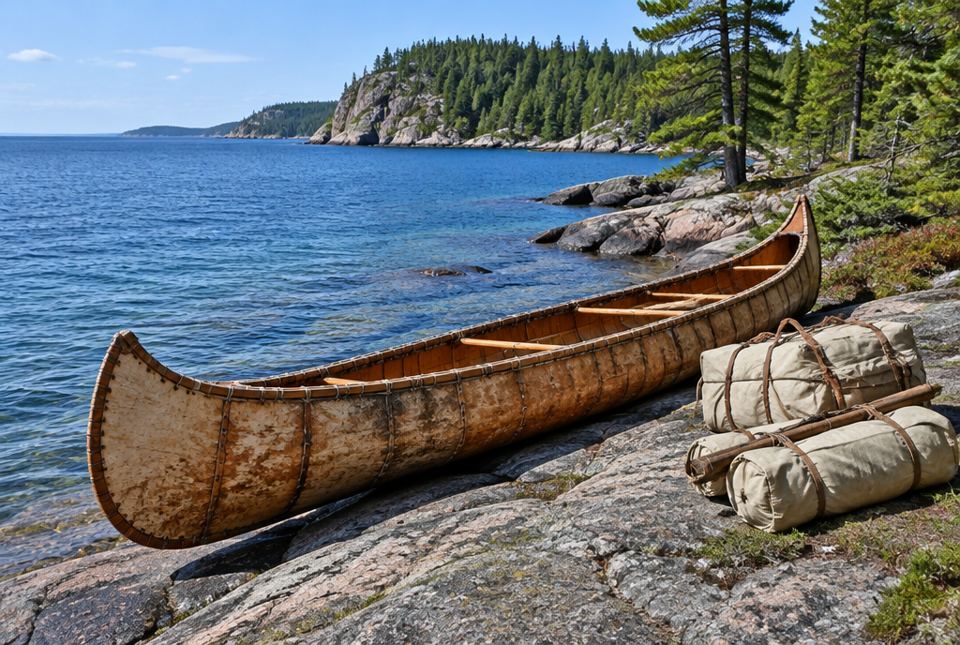 Voyageurs paddled big canoes like this across the Great Lakes, carrying trade goods and furs. Living and working far from home in First Nations lands, many formed families there, and the Métis people grew from these families. AI-generated image
Factor 2: Families and kinship
Many traders married First Nations women, often Anishinaabe and other nations of the Great Lakes, following the women's nations' customs. People called this marriage "in the custom of the country."
These marriages mattered for trade. A trader joined his wife's kinship network, which meant he had family responsibilities and trading partners he could trust.
First Nations women were key to the fur trade. They knew the languages, the land and the people. They made moccasins, snowshoes and clothing, prepared food for long journeys, and prepared furs.
Factor 3: Children who belonged to the fur trade world
The children of these families grew up knowing both First Nations and French ways. Many spoke several languages. As adults, many worked as interpreters, guides, voyageurs and traders: jobs that needed exactly those skills.
Factor 4: Communities along the water routes
Families settled near trading posts along the busy water routes, such as Sault Ste. Marie, Michilimackinac, around Georgian Bay, and at Mattawa.
Mattawa is where the Mattawa River meets the Ottawa River. Canoes going between Montréal and the upper Great Lakes passed this way: up the Ottawa River, along the Mattawa River to Lake Nipissing, down the French River to Georgian Bay, and on across Lake Huron.
Factor 5: A distinct people
Over generations, these families married each other, lived near each other and built their own way of life: their own customs, music, clothing and sense of who they were. They were different from both their First Nations and their French ancestors. This is ethnogenesis: the birth of a new people.
This took a long time. It began with fur-trade families in the late 1600s, but distinct Métis communities grew mostly after 1713, through the 1700s and 1800s. Historians do not all agree on exactly when and where each community first formed.
Important
Not everyone with both First Nations and European ancestors is Métis. The Métis are a distinct people, with their own history, communities, culture and nation. Being Métis is about belonging to that people and its communities.
Word funEthnogenesis has five syllables: eth-no-GEN-e-sis. Can you say it three times fast? Then explain what it means to someone at home, and you'll be the family vocabulary champion!
The Métis today
The Métis are one of the three Indigenous peoples recognized in Canada's Constitution, along with First Nations and Inuit.
In 2003, the Supreme Court of Canada decided in the Powley case that a Métis community around Sault Ste. Marie has the right to hunt for food. In 2017, Ontario and the Métis Nation of Ontario named more historic Métis communities in the province, including one along the Mattawa and Ottawa River. Some First Nations and Métis organizations disagree with some of these findings, and the discussion continues.
The best-known Métis flag shows a white infinity symbol on a blue background. It stands for two cultures coming together, and for a people who will last forever.
Worked exampleLet's connect the factors
Put these events in order, to show how a Métis family might begin: (a) their grandchildren grow up in a community of families like theirs, with its own customs; (b) a French trader comes to a Great Lakes trading post; (c) their children work as interpreters and voyageurs; (d) he marries an Anishinaabe woman in the custom of the country.
- What comes first? The trader has to arrive: (b).
- Next, he joins a family through marriage: (d).
- Their children grow up and use both ways of life in the fur trade: (c).
- Over generations, a distinct community forms: (a).
b, d, c, a. Ethnogenesis takes generations, not one lifetime.
Hands-on activityFamily-and-place web
You need: a big sheet of paper and coloured pencils.
- In the centre, draw a canoe at a trading post beside a river. Label it Mattawa or Sault Ste. Marie.
- Draw lines out to the five factors: the fur trade, families and kinship, children with both ways, communities on water routes, and a distinct people.
- On each line, draw a small picture and write one sentence. Example: for kinship, draw two hands joined and write "Marriage made the trader part of a family network."
- Explain your web to someone at home, starting from the centre.
Bonus: with a grown-up, find Mattawa and Sault Ste. Marie on a map of Ontario.
Your turn
1What does ethnogenesis mean?
The birth of a new people with its own identity, culture and community.
2What part did First Nations women play in the fur trade?
They knew the languages, land and people; made moccasins, snowshoes and clothing; prepared food and furs; and linked traders to kinship networks.
3Why did marriage help a trader in the fur trade?
He joined his wife's kinship network, which gave him trusted trading partners and family responsibilities.
4Name two places where early Métis communities grew in what is now Ontario.
Any two: Sault Ste. Marie, Mattawa (Ottawa River), Georgian Bay (and nearby places).
5Why was Mattawa an important place?
It is where the Mattawa River meets the Ottawa River, on the canoe route between Montréal and the upper Great Lakes.
6Is everyone with First Nations and European ancestors Métis?
No. The Métis are a distinct people with their own communities, history and culture.
More practice: warm-up
A canoe paddler who carried goods and furs on fur-trade routes.
Family ties, including ties made by marriage.
3What symbol is on the best-known Métis flag?
4What happened in the Powley case in 2003?
The Supreme Court of Canada decided a Métis community around Sault Ste. Marie has the right to hunt for food.
5Name the three Indigenous peoples recognized in Canada's Constitution.
First Nations, Métis and Inuit.
More practice: on your own
1Why did Métis communities grow near trading posts on water routes?
That is where the fur trade happened. The work (guiding, paddling, interpreting, trading) was there, and families gathered there.
2Why were the children of these families so useful in the fur trade?
They knew both ways of life and often several languages, so they made great interpreters, guides and traders.
3Follow the canoe route from Montréal: which river do you take first, and which lake do you reach after the Mattawa River?
First the Ottawa River; after the Mattawa River you reach Lake Nipissing.
4Why did Métis ethnogenesis take generations?
A new people forms as families marry each other, live together and build shared customs over a long time. One family alone is not a people.
5What does the infinity symbol on the Métis flag stand for?
Two cultures coming together, and a people who will last forever.
Challenge
1Explain how the fur trade was a cause of Métis ethnogenesis. Use at least two factors.
The fur trade brought French traders into First Nations lands and kept them there; trade made marriages and kinship valuable; the trade gave their children jobs that used both cultures; and families gathered at trading posts, forming communities that became a distinct people.
2Why would historians look at the Great Lakes and Mattawa regions in particular?
They were on the main fur-trade water routes, with trading posts where traders and First Nations families met and stayed. Communities like Sault Ste. Marie and Mattawa grew there.
3Why do you think the Supreme Court's Powley decision mattered to Métis people?
It recognized that a Métis community existed historically and has rights today (like hunting for food), showing the Métis as a distinct people with rights.
Quiz
1. What does ethnogenesis mean?
2. Which was a key factor in Métis ethnogenesis?
3. Mattawa is where the Mattawa River meets the...
5. In the Powley case (2003), the Supreme Court recognized a Métis community near...
6. Why did Métis ethnogenesis take so long?
Big idea: The Métis became a distinct Indigenous people over generations, through the fur trade, marriages and kinship, children who worked in the trade, and communities along water routes, especially in the Great Lakes and Mattawa regions (A3.6).
How to help at home:
- Use the word "distinct" and stress that being Métis is about belonging to a people and its communities, not a percentage of ancestry.
- Find Mattawa and Sault Ste. Marie on a map; trace the canoe route from Montréal.
- The Métis Nation of Ontario website has information for families.
Common difficulties:
- "Métis means mixed": this is a common misunderstanding; the Métis are a distinct people with their own nation.
- Timing: the process began in the fur trade of the 1600s but grew mostly in the 1700s and 1800s, after 1713. That is fine; the curriculum asks about the factors.
- A note for parents: which historic Métis communities existed in Ontario, and who belongs to them, is a subject of ongoing public discussion, including among First Nations and Métis organizations. This lesson follows the curriculum's wording and the 2003 Supreme Court decision. If your child asks, it is fine to say that people are still discussing it.