C. Matter and Energy · Properties of and Changes in MatterSolids, Liquids and Gases
C2.2 A1.5About 35 minutes
Learning goals- I can name the three states of matter and give examples of each.
- I can describe the shape and volume of solids, liquids and gases.
- I can use the particle model to describe how particles are arranged in solids, liquids and gases.
- I can explain why some tricky materials, like sand, are solids.
Words to know
state of matter
The form matter is in: solid, liquid or gas.
solid
Matter that keeps its own shape and its own volume.
liquid
Matter that keeps its own volume but takes the shape of its container. Liquids flow.
gas
Matter that has no shape or volume of its own. It spreads out to fill any container.
particle
A tiny piece of matter, much too small to see. All matter is made of particles.
compress
To squeeze something into a smaller space.
Three kinds of matter in one glass
Imagine a glass of cold chocolate milk with ice cubes and a few bubbles on top.
- The ice cubes are a solid.
- The milk is a liquid.
- The bubbles are full of air, which is a gas.
Solid, liquid and gas are the three states of matter you see every day. (Scientists know about other states too, but these three are the ones we study in Grade 5.)
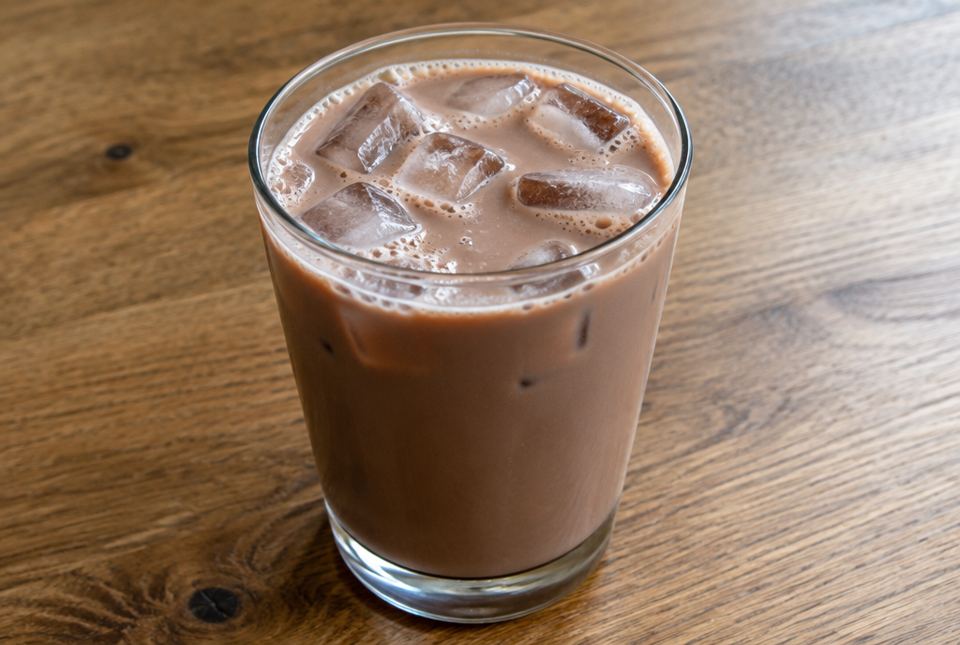 Three states of matter in one glass: the ice cubes are solid, the chocolate milk is liquid, and the bubbles hold air, a gas. AI-generated image
🧊🧊🧊💧💧💧💨💨💨
Ice cubes (a solid), drops of water (a liquid) and puffs of air (a gas).Solids
A solid keeps its own shape and its own volume. A wooden block is a cube whether it is in a box or on a table. You can't pour a solid block, and you can hardly squeeze it smaller.
Examples: a rock, a hockey puck, ice, a chair, a maple leaf.
Liquids
A liquid has its own volume but no shape of its own. It flows and takes the shape of whatever container it is in. 250 mL of water is still 250 mL in a tall glass or a flat dish. Liquids are very hard to squeeze smaller.
Examples: water, milk, maple syrup, cooking oil, juice.
Gases
A gas has no shape and no volume of its own. It spreads out to fill all of whatever container it is in. Gases can be compressed (squeezed) into a smaller space. That is how lots of air fits inside a bicycle tire.
Most gases are invisible. You can tell they are there because they push on things, fill things up or have a smell.
Examples: air, water vapour, the helium in a party balloon, the carbon dioxide bubbles in sparkling water.
| Solid | Liquid | Gas |
|---|
| Own shape? | yes | no, takes the container's shape | no, fills the whole container |
| Own volume? | yes | yes | no, spreads out to fill the space |
| Does it flow? | no | yes | yes |
| Can it be squeezed smaller? | hardly at all | hardly at all | yes, easily |
| Example | a hockey puck | maple syrup | the air in a tire |
Why are they different? The particle model
Scientists picture all matter as made of tiny particles, much too small to see, even with a magnifying glass. The particles are always moving. How they are arranged decides the state:
- Solid: particles are packed tightly in place. They can only jiggle (vibrate). That is why a solid keeps its shape.
- Liquid: particles are still close together, but they can slide past each other. That is why a liquid flows but keeps its volume.
- Gas: particles are far apart and zoom around in all directions. That is why a gas spreads out and can be squeezed: there is lots of empty space between the particles.
Worked exampleLet's classify some tricky materials
Is each one a solid, a liquid or a gas? honey, a wooden block, sand, the air in a bike tire
- Honey flows (slowly!) and takes the shape of its jar, but keeps its volume → liquid.
- A wooden block keeps its shape and volume → solid.
- Sand can be poured, which seems like a liquid. But look at one grain with a magnifying glass: each grain keeps its own shape. Sand is a lot of tiny solids. The same is true for salt, sugar and flour.
- The air in a bike tire fills the whole tire and has been squeezed in with a pump → gas.
Honey: liquid. Wooden block: solid. Sand: solid (many tiny grains). Air in a tire: gas.
Pouring is not enough
If a material pours, check the pieces. If each piece keeps its own shape (sand, rice, sugar), it is a solid in small pieces. A true liquid has no pieces that keep their shape.
Just for funWhat did the solid say to the gas?
"Why are you always so spaced out?" (It's true: gas particles are far apart, with lots of empty space between them!)
Hands-on activityShape, volume and squeeze tests
You need: a measuring cup, water, 3 differently shaped clear containers (a tall glass, a bowl, a plastic food container), 3 ice cubes, 2 empty plastic bottles with caps (the same size), a towel.
- Liquid test: Measure 100 mL of water. Pour it into the tall glass, then the bowl, then the food container. Each time, pour it back into the measuring cup. Does the shape change? Does the volume change?
- Solid test: Put an ice cube in each container. Does the ice cube change shape to fit the container? (Do this quickly, before it melts much.)
- Gas squeeze test: Put the cap tightly on an empty bottle (it is full of air). Squeeze it. Now fill the second bottle all the way to the top with water, cap it tightly over a sink, and squeeze. Which one squeezes more?
- Make a table with three rows (solid, liquid, gas) and two columns (shape and volume). Fill it in from what you saw.
What to look for: the water changes shape but is always 100 mL. The ice cubes keep their shape. The air-filled bottle squeezes much more easily than the water-filled bottle, because the particles of a gas are far apart.
Safety: do the water bottle squeeze over the sink. Wipe up spills. Don't eat the ice cubes used in the test.
Your turn
1Name the three states of matter.
2Which state keeps its own shape?
3Which state takes the shape of its container but keeps its own volume?
4Which state spreads out to fill its whole container?
5In which state are the particles packed most tightly?
Solid. The particles are packed in place and can only jiggle.
6Give one example of each state that you can find in your kitchen.
Many answers. For example: solid: a spoon, a potato; liquid: water, milk, cooking oil; gas: the air in the kitchen, the invisible water vapour from a boiling kettle.
7Why can lots of air be pumped into a bike tire?
Gases can be compressed. Their particles are far apart, so they can be squeezed closer together.
More practice: warm-up
1Solid, liquid or gas: a hockey puck?
2Solid, liquid or gas: orange juice?
3Solid, liquid or gas: the helium in a party balloon?
4Solid, liquid or gas: a maple leaf?
Yes. Liquids flow and can be poured.
More practice: on your own
1Salt can be poured. Why is it still a solid?
Each salt grain keeps its own shape and volume. Salt is many tiny solids.
2You pour 500 mL of milk from a carton into a pitcher. Describe what happens to its shape and volume.
The shape changes to fit the pitcher. The volume stays 500 mL. That is how liquids behave.
3Use the particle model to explain why a liquid can flow.
In a liquid the particles are close together but can slide past each other, so the liquid can move and change shape.
4When someone opens a jar of pickles, you can smell them across the room. What does that tell you about gases?
Gases spread out to fill the space. Tiny particles of the smell move through the air and reach your nose.
5Why is it so hard to squeeze a capped bottle that is completely full of water?
Liquid particles are close together, with very little space between them, so a liquid can hardly be squeezed smaller.
Challenge
1Toothpaste comes out of the tube and changes shape, but a line of toothpaste sits on the brush and doesn't flow off. Is it easy to classify? What could you say?
Not easy! Some materials, like toothpaste, act a bit like a solid and a bit like a liquid. A good answer describes what it does: it keeps its shape when left alone, but flows when you squeeze it. Scientists study materials like this carefully.
2Draw the particles in a solid, a liquid and a gas. What should your drawing show?
What to look for: solid: particles touching in neat rows; liquid: particles touching but jumbled, filling the bottom of the container; gas: only a few particles far apart, spread through the whole container.
3A sealed syringe with no needle is full of air. If you block the tip and push the plunger, it moves in a little. If it were full of water, it would barely move. Explain.
Air is a gas, with lots of space between its particles, so it can be compressed. Water is a liquid: its particles are already close together, so it can hardly be squeezed.
Quiz
1. Which state of matter keeps its own shape?
3. Which can be squeezed into a smaller space most easily?
4. In which state are particles far apart and moving fast in all directions?
5. Sand pours like a liquid, but it is a solid because...
Big idea: Ontario Grade 5 expectation C2.2 asks children to identify the states of matter and describe characteristics and properties of solids, liquids and gases. The particle model (tightly packed, close but sliding, far apart) is a simple way to explain those properties and prepares for changes of state later in the unit. Sharing a results table practises A1.5.
How to help: Play "solid, liquid or gas?" in the kitchen or at the grocery store. Ask why each time: "Does it keep its shape? Does it fill the container?"
Common difficulties:
- Calling sand, salt or flour liquids because they pour. Look at single grains.
- Thinking gases are "nothing". Remind your child of the dry tissue in the upside-down cup from the last lesson.
- Thinking a liquid changes volume when it changes containers. Pour the same 100 mL back and forth.
Safety: do squeeze tests over the sink, and keep test ice cubes out of mouths.