E. Earth and Space Systems · Rocks, Minerals, and Geological ProcessesFirst Nations, Métis and Inuit Knowledges of Rocks and Minerals
E2.6 A3.3 A1.1About 45 minutes
Learning goals- I can describe how First Nations, Métis and Inuit knowledges guide the choice of rocks and minerals for specific purposes.
- I can give examples, like chert for sharp tools, copper for tools, red ochre for paint, and soapstone for the qulliq and carvings.
- I can connect these choices to the properties of the rocks and minerals.
- I can explain how to learn about Indigenous knowledges respectfully.
Words to know
Indigenous knowledges
Knowledge that First Nations, Métis and Inuit peoples have built up over thousands of years of living with the land, and pass on through teachings, stories, language and practice.
knowledge keeper
A person in a First Nations, Métis or Inuit community who holds and shares traditional knowledge and teachings.
chert
A hard sedimentary rock made of tiny quartz crystals. It breaks with sharp, curved edges. Flint is a kind of chert.
red ochre
A soft, earthy form of the iron mineral hematite that makes a red powder, used to make paint.
soapstone
A soft rock, made mostly of the mineral talc, that is easy to carve and holds heat well.
qulliq
A traditional Inuit lamp carved from soapstone. It burns animal oil and gives light and heat.
Knowledge of the land
First Nations, Métis and Inuit peoples have lived on the lands now called Canada for thousands of years, and they live here today in many different communities across the country. Over that long time, they have built up deep knowledge of the land, including its rocks and minerals: where to find them, what they can do, and how to use them with care and respect.
This knowledge is passed on by Elders and knowledge keepers through teachings, stories, language and doing things together. Each nation and community has its own knowledge, language and ways. There is not just one "Indigenous way"; that is why we say knowledges (more than one).
A respectful way to learn
- Learn from First Nations, Métis and Inuit people and organizations themselves: books by Indigenous authors, community websites, cultural centres, museums that work with communities, and knowledge keepers who are invited to share.
- In many First Nations communities, it is respectful to offer tobacco when asking a knowledge keeper to share teachings. Ask your teacher or the community what is right.
- Some places and objects are sacred. Never take rocks, or touch carvings or paintings, at sacred sites. Follow the rules the community has set.
- Some knowledge is not meant to be shared with everyone. Respect that.
Choosing the right rock for the purpose
For thousands of years, First Nations, Métis and Inuit peoples have chosen rocks and minerals by their properties, the same properties you have been testing in this unit. Here are some examples:
Chert (flint) for sharp tools. Chert is hard and, like obsidian and glass, it breaks with sharp, curved edges. Skilled makers chipped chert into knives, scrapers and arrow and spear points. In southern Ontario, the ancestors of today's First Nations used a chert called Onondaga chert, found in limestone near Lake Erie, and traded it widely.
Copper for tools and ornaments. Around Lake Superior, pure copper can be found right in the rock. For thousands of years, Indigenous peoples of the Great Lakes region hammered and heated this copper into knives, fishhooks, awls and beautiful ornaments. These are some of the oldest metal tools in North America. Copper is soft enough to shape by hammering, and it doesn't shatter.
Red ochre for paint. Red ochre is an earthy form of the iron mineral hematite. Remember its red-brown streak? Ground into powder and mixed with other materials, it makes a long-lasting red paint. At Agawa Rock in Lake Superior Provincial Park, red ochre images painted on the rock by Ojibwe (Anishinaabe) people can still be seen today. Red ochre is also used in ceremonies.
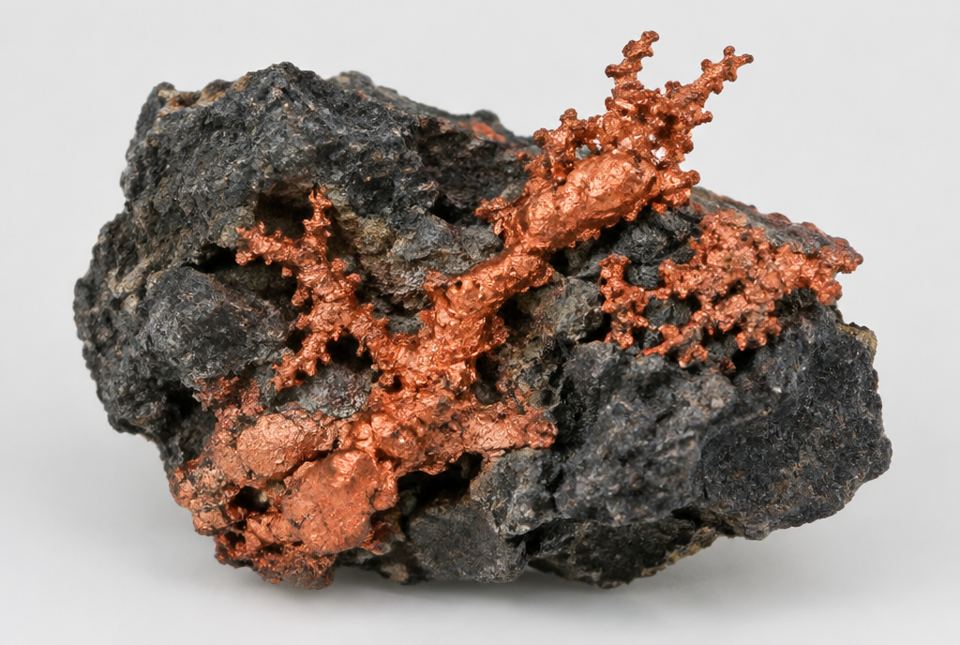 Pure copper like this can be found right in the rock around Lake Superior. It is soft enough to hammer into shape, which made it a good material for tools and ornaments. AI-generated image
Soapstone for the qulliq and for carving. Soapstone is soft (mostly talc, the softest mineral on the Mohs scale), so it can be carved with tools. It also holds heat and doesn't crack easily when it is warmed. Inuit traditionally carved soapstone into the qulliq, a lamp that burns seal oil. The qulliq gave light and heat, melted snow and ice for drinking water, and helped cook food and dry clothes. Today, the qulliq is still lit at special events, and Inuit artists carve stone sculptures that are admired around the world.
Stones for inuksuit. Inuit build inuksuit (one is an inuksuk) by carefully choosing and stacking stones so they stay standing through Arctic winds and winters. Inuksuit can mark travel routes, good hunting or fishing places, or places where food is stored. An inuksuk on the flag of Nunavut shows how important they are.
Rocks that teach. Near Peterborough, at Petroglyphs Provincial Park, hundreds of images are carved into a large slab of white marble. The Anishinaabe call this place Kinoomaagewaapkong (Ontario Parks spells it Kinomagewapkong), "the rocks that teach". It is a sacred place today, and visitors are asked to treat it with respect. In many Anishinaabe teachings, rocks are respected as Grandfathers, because they are among the oldest beings on Earth.
Métis knowledges. Métis people also have land-based knowledge that is passed down in families and communities. To learn about it, look to Métis organizations, such as the Métis Nation of Ontario, and Métis knowledge keepers.
| Rock or mineral | Key property | Purpose |
|---|
| chert | hard; breaks with sharp, curved edges | knives, scrapers, arrow and spear points |
| copper | soft metal; can be hammered into shape without breaking | knives, fishhooks, awls, ornaments |
| red ochre (hematite) | makes a red-brown powder | paint for images on rock; ceremonies |
| soapstone | soft enough to carve; holds heat; doesn't crack easily when warmed | the qulliq (lamp), pots, carvings |
| stones for an inuksuk | shapes that stack and stay stable | markers on the land |
Worked exampleLet's match properties to purposes
You need to choose a rock for each job: (a) a cutting edge, (b) a lamp that will hold burning oil, (c) red paint. Choose from soapstone, red ochre, chert, and explain using properties.
- (a) A cutting edge needs a hard rock that breaks with sharp edges. That is chert.
- (b) A lamp must be carved into a bowl and must handle heat without cracking. Soapstone is soft enough to carve and holds heat well. That is soapstone.
- (c) Paint needs a mineral that makes a coloured powder. Red ochre makes a red powder (like hematite's red-brown streak). That is red ochre.
(a) chert, (b) soapstone, (c) red ochre. Each choice depends on the rock's properties, the same knowledge geologists use.
How a mineral becomes paint: the mineral is ground into a red-brown powder (the same colour as hematite's streak) and mixed with a binder that makes it stick.Knowledge for today and tomorrow
First Nations, Métis and Inuit knowledges are not only about the past. Today:
- Many Indigenous people work as geologists, engineers, artists, land guardians and educators.
- Communities share knowledge about the land when decisions are made about mining and protecting water and wildlife (you'll learn more in the next lesson).
- Knowledge about respect for the land, taking only what you need and thinking about future generations, helps all of us care for the Earth.
Hands-on activityEarth paint from streak powder
Red ochre paint is made from mineral powder. Let's explore how mineral colours can become paint. (We will paint our own designs; we do not copy sacred images like the paintings at Agawa Rock.)
You need: rocks from your collection, a piece of concrete sidewalk or the back of an unglazed tile, a small spoon, a little water, a few drops of white glue, a paintbrush or cotton swab, paper, safety glasses.
- With a grown-up, rub each rock on the rough tile or a hidden spot of concrete. Look at the streak powder colour. Which rocks make red, brown, yellow, grey or black powder? (A red brick also makes red-brown powder, because it is made from iron-rich clay.)
- Scrape a little of the most colourful powder into a spoon. Wear safety glasses while you rub and scrape.
- Add a drop of water and a drop of glue. Stir.
- Paint a small picture of a place on the land that is special to you.
- Write: Which rock made the best paint? Which property made it good for paint?
- Research (with a grown-up): Find out about one First Nations, Métis or Inuit artist, scientist or knowledge keeper whose work connects to rocks, minerals or the land. Use a source from an Indigenous organization or a museum that works with communities. Write 3 things you learned and where you found them.
Wash your hands after. Don't breathe in the powder: work slowly, and don't blow on it.
Your turn
1Why do we say Indigenous knowledges instead of just "knowledge"?
Because each First Nation, Métis community and Inuit community has its own knowledge, language and ways. There are many knowledges, not just one.
2Why was chert chosen for knives and arrow points?
It is hard and breaks with sharp, curved edges.
3What is red ochre, and what is it used for?
An earthy form of the iron mineral hematite. Ground into powder, it makes red paint (and is used in ceremonies).
4What is a qulliq made of, and what is it used for?
Soapstone. It is a lamp that burns oil to give light and heat, melt snow for water, cook food and dry clothes.
5Why is soapstone a good choice for a lamp?
It is soft enough to carve into a bowl shape and it holds heat without cracking easily.
6Name one respectful way to learn about Indigenous knowledges.
Learn from Indigenous people and organizations themselves (books by Indigenous authors, cultural centres, invited knowledge keepers); offer tobacco when appropriate; respect sacred sites and knowledge that is not meant to be shared.
A structure of carefully chosen, stacked stones built by Inuit, used for example to mark routes or good hunting and fishing places.
More practice: warm-up
1Around which Great Lake can pure copper be found right in the rock?
2What do the Anishinaabe call the place at Petroglyphs Provincial Park?
Kinoomaagewaapkong, "the rocks that teach".
3What kind of rock are the petroglyphs carved into?
4Is soapstone soft or hard?
Soft. It is made mostly of talc.
5True or false: First Nations, Métis and Inuit knowledges are only about the past.
False. They are living knowledges used today.
More practice: on your own
1Copper tools were hammered into shape. Why would that not work with chert?
Chert is brittle: hitting it makes it break into pieces with sharp edges. Copper is a metal that bends and changes shape without shattering.
2Connect red ochre to something you learned in the mineral testing lesson.
Red ochre is a form of hematite, and hematite has a red-brown streak. The streak test shows the colour of its powder, which is the colour of the paint.
3Why might it matter which stones are chosen for an inuksuk that must last for many years?
The stones must be the right shape and size to stack steadily, so the inuksuk stays standing through strong winds, snow and ice.
4Why should you never take a small rock from a sacred site, even as a souvenir?
The place is sacred to the community. Taking anything is disrespectful, may break the community's rules or the law, and harms the site.
5In the paint activity, why do we paint our own design instead of copying the Agawa Rock images?
The images are sacred and belong to the Anishinaabe people's culture. Copying them without permission is not respectful.
Challenge
1Explain how choosing chert for a knife and choosing granite for a staircase use the same kind of thinking.
Both choices start with the job and then match the rock's properties to it: chert breaks with sharp edges for cutting; granite is hard and resists weathering for steps. Both use careful observation of how rocks behave.
2A community knowledge keeper says, "Take only what you need." How could this idea help with how we use rocks and minerals today?
Examples: mine less by reusing and recycling metals, keep devices longer, avoid wasting materials like road salt and gravel, and protect land and water for future generations.
3Plan a short research project about one Indigenous use of a rock or mineral. Name your question, two good sources, and how you would share what you learn.
Example question: "How is a qulliq made and used?" Sources: an Inuit organization's website or an Inuit cultural centre, a book by an Inuit author, a museum that works with Inuit communities. Share: a poster or slideshow with labelled pictures, crediting the sources and the community. Any well-planned answer using Indigenous sources is correct.
Quiz
1. Why was chert used for knives and arrow points?
2. The qulliq is a lamp made of...
3. Red ochre is a form of which mineral?
4. Copper from around Lake Superior was made into tools by...
5. Which is a respectful way to learn about Indigenous knowledges?
6. Kinoomaagewaapkong at Petroglyphs Provincial Park means...
Big idea (E2.6): First Nations, Métis and Inuit peoples hold distinct, living geological knowledges that guide the selection of rocks and minerals for specific purposes, based on deep understanding of their properties: chert for edged tools, native copper for tools and ornaments, red ochre for paint, soapstone for the qulliq and carving, stones for inuksuit. This lesson also connects to contributions from diverse communities (A3.3).
How to help: Find out whose traditional territory you live on and look for local Indigenous cultural centres, Friendship Centres or community websites. Good starting points: Ontario Parks pages for Agawa Rock (Lake Superior Provincial Park) and Petroglyphs Provincial Park; the Inuit Tapiriit Kanatami website for the qulliq; the Métis Nation of Ontario for Métis perspectives. Present these communities as living and current.
Common difficulties:
- Treating all Indigenous peoples as one group. Emphasize distinct nations and the plural "knowledges".
- Speaking only in the past tense. These practices, knowledges and communities are active today.
- Seeing this as separate from "real" science. Selecting materials by their properties is the same reasoning geologists use.
Note on Métis content: We did not include a specific Métis geological example because we could not confirm one from a reliable source. Your child's teacher or the Métis Nation of Ontario can suggest local Métis resources and knowledge keepers.
Safety: Safety glasses when making streak powder; don't breathe in the dust; wash hands.