C. Matter and Energy · Light and SoundVibrations Make Sound: Pitch and Loudness
C2.5 C2.4 A1.2 A1.4 A3.3About 35 minutes
Learning goals- I can explain that sound is a form of energy made when something vibrates.
- I can explain how vibrations make sound waves.
- I can explain that faster vibrations make a higher pitch and slower vibrations make a lower pitch.
- I can explain that bigger vibrations make a louder sound.
- I can investigate how to change the pitch of a homemade instrument, and protect my hearing.
Words to know
sound
A form of energy that we hear. It is made when something vibrates.
vibrate
To move back and forth very quickly.
vibration
A quick back-and-forth movement.
sound wave
The pattern of vibrations that carries sound energy through air, water or solids.
pitch
How high or low a sound is.
loudness (volume)
How loud or soft a sound is.
decibel (dB)
A unit used to measure how loud a sound is.
Feel the buzz
Put your fingers gently on the front of your throat. Now hum a song. What do you feel? A tiny buzzing! Stop humming, and the buzzing stops.
That buzz is a vibration, and it is the secret behind every sound you have ever heard.
Sound is energy made by vibrations
Sound is a form of energy. Every sound starts when something vibrates: it moves back and forth very quickly.
- When you talk or sing, your vocal cords in your throat vibrate.
- When you pluck a guitar string, the string vibrates.
- When you hit a drum, the skin of the drum vibrates.
- When a bee buzzes, its wings vibrate.
The vibrating object pushes on the air around it, again and again. Those pushes pass through the air as a sound wave. When the sound wave reaches your ears, you hear the sound.
Vibrations are often too fast to see. But you can sometimes feel them, or see what they do: sprinkle rice on a drum, hit it, and the rice jumps!
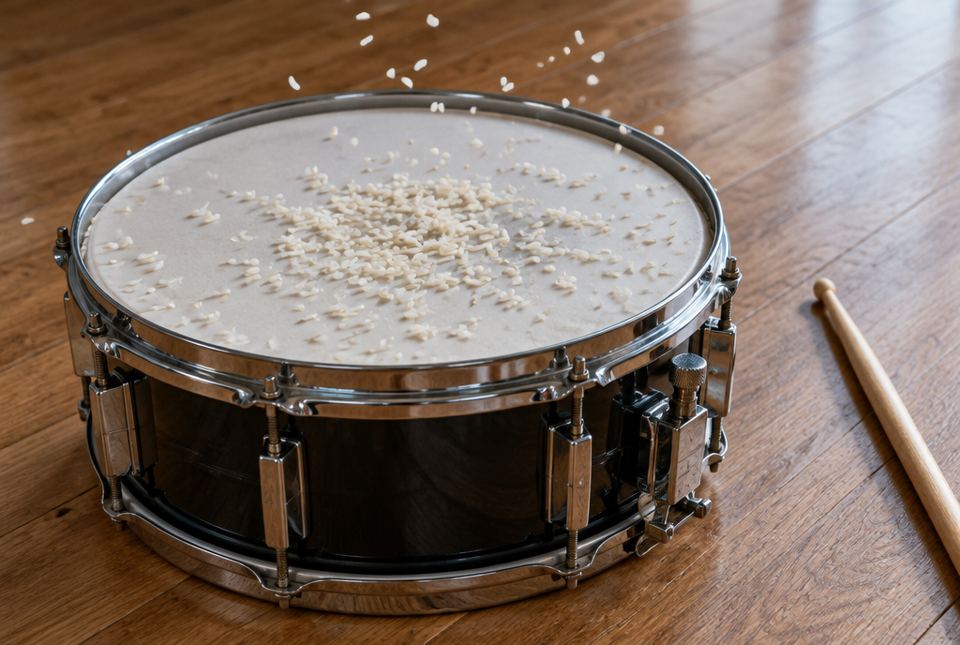 You cannot see the drum skin vibrate, but you can see what the vibrations do: they make the rice jump. AI-generated imageA plucked string vibrates back and forth very quickly. The vibrations push on the air and make a sound wave.
Pitch: high or low?
Pitch is how high or low a sound is. A bird's tweet has a high pitch. A big truck's rumble has a low pitch.
- Fast vibrations make a high pitch.
- Slow vibrations make a low pitch.
On a string instrument:
- Shorter strings vibrate faster → higher pitch.
- Thinner strings vibrate faster → higher pitch.
- Tighter strings vibrate faster → higher pitch.
On a drum, a tighter skin makes a higher sound, and a big, loose drum makes a lower sound.
Loudness: soft or loud?
Loudness (also called volume) is how loud or soft a sound is. It depends on how big the vibrations are.
- A gentle pluck makes small vibrations → a soft sound.
- A strong pluck makes big vibrations → a loud sound. A big vibration carries more energy.
Pitch and loudness are different. A tiny whistle can be high and loud. A cat's purr is low and soft.
| Sound | About how loud (decibels) |
|---|
| a whisper | 30 dB |
| people talking | 60 dB |
| busy traffic | 85 dB |
| a gas lawn mower | 90 dB |
| a siren close by | 120 dB |
Protect your hearing
Very loud sounds, or loud sounds that go on for a long time, can damage your hearing forever. Sounds around 85 dB or louder, heard for a long time, can be harmful.
- Keep headphones and earbuds at a medium volume. A common tip: no more than about 60% volume, and take breaks.
- If you have to shout to be heard by someone an arm's length away, it is too loud.
- Wear earplugs or earmuffs near lawn mowers, snow blowers, power tools, fireworks and loud concerts.
- Never shout or blow a whistle right into someone's ear.
The drum in First Nations communities
In many First Nations communities, the drum is very important. It is used in songs, dances, ceremonies and gatherings such as powwows. Many drums are made by stretching animal hide over a round wooden frame. When the drummer strikes the hide, it vibrates and makes a deep sound that can be felt as well as heard. Many First Nations people describe the drumbeat as a heartbeat.
Drums are treated with great respect. Some drums are sacred, and only certain people may play them. If you go to a powwow, listen and follow what the hosts ask, such as when to stand and when not to take photos.
Just for funFunny but true: a honeybee beats its wings about 230 times every second. That is far too fast to see, so instead of hearing "flap, flap, flap" you hear a steady bzzzz!
Worked exampleLet's change the pitch of a rubber-band guitar
Omar stretched three rubber bands around an empty tissue box: a thick band, a medium band and a thin band. All three were the same length around the box. He plucked each one gently and listened.
- Observe: the thick band made the lowest sound. The thin band made the highest sound.
- Explain: the thin band is lighter, so it vibrates faster. Faster vibrations make a higher pitch.
- Next test: Omar slid a pencil under the thin band to make the part he plucked shorter. The sound got higher. Shorter → faster vibrations → higher pitch.
- Loudness test: he plucked the medium band gently, then strongly. The pitch stayed the same, but the strong pluck was louder, because the vibrations were bigger.
Thinner or shorter bands vibrate faster and make a higher pitch. A stronger pluck makes bigger vibrations and a louder sound, but does not change the pitch.
Hands-on activitySound lab
You need: an empty tissue box (or a plastic container with no lid), 3 rubber bands of different thicknesses, a pencil, a bowl, plastic wrap, a few grains of uncooked rice, a metal pot and a wooden spoon, and a ruler.
- Feel it: hum with your fingers on your throat. Hum high, then low. Is the buzz different?
- Ruler twang: hold a ruler flat on a table so most of it sticks out over the edge. Press down hard on the part on the table and flick the free end. Then slide the ruler so only a short piece sticks out and flick again. Which makes a higher sound?
- Rubber-band guitar: do Omar's test. Record what you hear in a table: band, pitch (high, medium, low).
- Dancing rice: stretch plastic wrap tightly over the bowl and sprinkle a few grains of rice on top. Hold the pot near the bowl (not touching) and tap it with the spoon. Watch the rice!
What to look for: the throat buzz changes when the pitch changes; a short piece of ruler makes a higher sound; thin or shortened bands make higher sounds; the rice jumps because sound waves from the pot make the plastic wrap vibrate.
Safety: keep rubber bands away from faces and eyes; they can snap. Tap the pot gently: protect everyone's hearing. Rice grains are small; pick them all up afterwards so little children and pets don't put them in their mouths.
Your turn
1What must happen for a sound to be made?
Something must vibrate (move back and forth quickly).
2What vibrates when you talk?
Your vocal cords in your throat.
How high or low a sound is.
4Do fast vibrations make a high pitch or a low pitch?
5What makes a sound louder?
Bigger vibrations (more energy), for example plucking or hitting harder.
6Name two ways to protect your hearing.
For example: keep headphones at a medium volume and take breaks; wear earplugs or earmuffs near loud machines and fireworks; move away from very loud sounds.
7Why did the rice jump on the plastic wrap?
Sound waves from the pot made the plastic wrap vibrate, and the vibrations bounced the rice.
More practice: warm-up
1High or low pitch: a mouse squeak?
2High or low pitch: a foghorn?
4What vibrates when you hit a drum?
The skin (head) of the drum.
5What unit is used to measure loudness?
More practice: on your own
1Two guitar strings are the same length. One is thick and one is thin. Which has the higher pitch? Why?
The thin string. It vibrates faster, and faster vibrations make a higher pitch.
2A drummer tightens the skin of a drum. What happens to the pitch? Why?
It gets higher. A tighter skin vibrates faster.
3You pluck a rubber band gently, then hard. What changes: the pitch or the loudness? Explain.
The loudness. The hard pluck makes bigger vibrations, so it is louder. The pitch stays the same.
4A snow blower is about 90 dB loud. Should the person using it protect their ears? Explain.
Yes. Sounds of about 85 dB or louder for a long time can damage hearing, so they should wear earmuffs or earplugs.
5Why can you feel a big drum's beat in your chest at a powwow or concert?
The drum makes big vibrations. The sound waves carry that energy through the air and make your body vibrate a little too.
Challenge
1A ruler sticks out 25 cm over a table edge. Then it sticks out 10 cm. Which twang has the higher pitch? Explain using the word vibrate.
The 10 cm twang. The shorter part vibrates faster, and faster vibrations make a higher pitch.
2Is it possible for a sound to be high and soft? Give an example.
Yes. Pitch and loudness are different. Example: a gentle tap on a small bell, or a quiet bird chirp, is high but soft.
3Design a test to find out if a longer or shorter rubber band makes a higher pitch. Say what you change and what you keep the same.
Change: only the length of band you pluck (move a pencil under the band to make it shorter). Keep the same: the same band, the same box, the same gentle pluck. Listen and record which is higher. (Result: the shorter part makes the higher pitch.)
Quiz
1. All sounds are made by...
2. Fast vibrations make a sound that is...
3. Plucking a string harder makes the sound...
4. Which string makes the highest pitch?
5. Which is the best way to protect your hearing at a fireworks show?
6. Many First Nations drums are made by stretching hide over a wooden frame. When struck, the hide...
Big idea: Ontario Grade 4 expectation C2.5 asks children to explain how vibrations cause sound waves. Pitch (high/low) depends on how fast something vibrates; loudness depends on how big the vibrations are. This also begins C2.4 (properties of sound). The rubber-band and ruler tests are simple investigations (A1.2), the hearing-safety rules connect to A1.4, and the drum section respectfully introduces an important part of many First Nations cultures (A3.3).
How to help: Make music together with pots, elastic bands or glasses of water. Ask "Is that higher or lower? Louder or softer? What is vibrating?"
Common difficulties:
- Mixing up pitch and loudness. Children often say "high" when they mean "loud". Practise: "Sing a high note softly. Now a low note loudly."
- Thinking sound is a "thing" that flies through the air. It is energy passed along by vibrations.
- Decibel numbers: the values in the table are approximate; the main idea is that very loud sounds can damage hearing.
Safety: supervise rubber bands (eye safety). Model good hearing habits: check headphone volume, and use hearing protection with loud tools and at fireworks.