A. Dance / C. Music · Music and DanceMusic: Low So, Low La and the Shape of a Melody
C1.1 C1.2 C1.5About 35 minutes
Learning goals- I can sing low so and low la, the notes just below do, with hand signs.
- I can hear whether a melody goes higher, lower or stays the same, and describe its contour (shape).
- I can draw a melody map of a song.
- I can sing a song in tune.
Words to know
pitch
How high or low a sound is.
melody
A line of pitches, one after another, that makes a tune.
contour
The shape of a melody: how it moves up, down or stays the same.
low so, low la
The pitches so and la sung below do. They are written so, and la, (with a little mark) to show they are low.
melody map
A picture that shows the shape of a melody, with dots or lines going up and down.
in tune
Singing the right pitches, matching the notes of the song.
Remember from Grade 2
In Grade 2 you sang do, re, mi, so, la and high do with hand signs. Those five notes make a pentatonic scale.
This year, we go down! Notes can go below do too. The two we will learn are low la and low so.
Going below do
Sing up the ladder: do, re, mi, so, la, do′ (high do).
Now start at do and go down: do... la, (low la)... so, (low so).
- Low la is the la just below do.
- Low so is the so just below low la.
We write them with a little mark: la, and so, (some books put the mark below the letters instead).
Hand signs: low la and low so use the same hand shapes as la and so, but your hand goes lower, below your waist, toward your hips.
- so: flat hand, palm facing you, held sideways.
- la: hand hanging loosely down from the wrist, like a drooping flower.
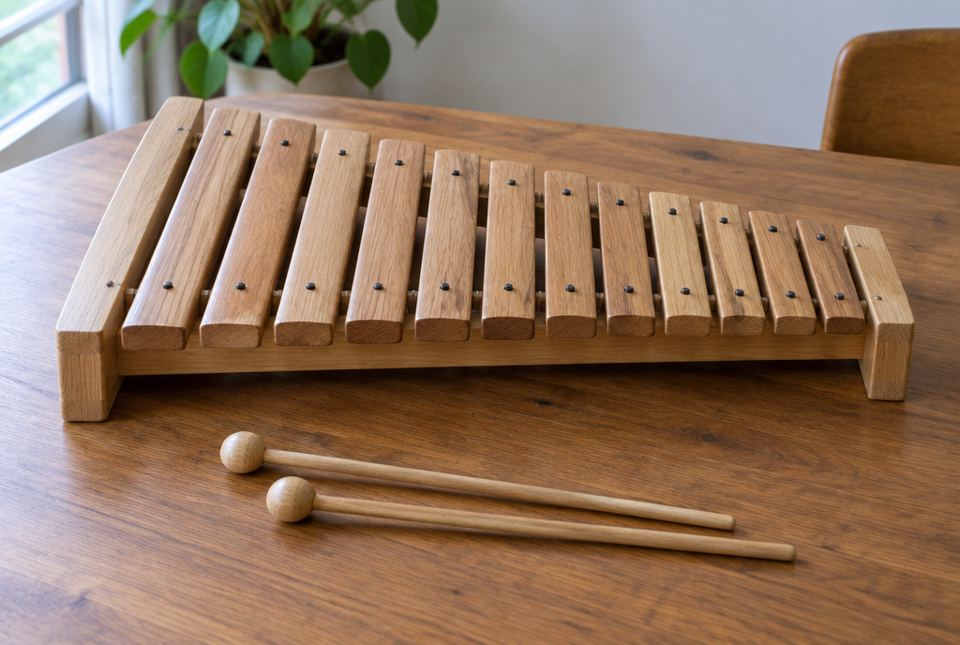 On a xylophone, the longer bars make lower notes and the shorter bars make higher notes. Low so and low la live on the longer bars. AI-generated image
| Pitch | Where your hand goes |
|---|
| high do (do′) | above your head |
| la | eyes |
| so | chin |
| mi | chest |
| re | between chest and waist |
| do | waist |
| low la (la,) | a little below your waist |
| low so (so,) | near your hips |
A song you know uses low so and low la!
Sing Old MacDonald Had a Farm. The first line goes:
Old (do) Mac (do) Don (do) ald (so,) had (la,) a (la,) farm (so,)
The melody starts on do, then jumps down to low so, steps up to low la, and back down to low so. That up-and-down shape is the melody's contour.
Melody shapes
Melodies can:
- step (move to the very next note, like do-re-mi),
- skip or leap (jump over notes, like do down to low so),
- repeat (stay on the same note, like do-do-do).
A melody map helps you see these moves. Higher dots mean higher pitches.
Worked exampleExample: Mapping *Happy Birthday*
The first line of Happy Birthday is: Hap (so,) py (so,) birth (la,) day (so,) to (do) you (ti,).
- Hap-py: two dots, both at low so (repeat).
- birth: a step up to low la.
- day: a step back down to low so.
- to: a leap up to do.
- you: a small step down to a note just below do, called ti. You will learn ti in a later grade; for now, notice it is a tiny step down.
- Contour: low, low, up a little, down, big leap up, small step down.
Happy Birthday begins below do, on low so. Its melody map looks like a small hill followed by a big jump.
Just for funJoke: Why did the singer bring a shovel to music class?
To dig down to low so!
Worked exampleExample: Writing my own melody with low notes
Let's write a 4-note melody for "Bears go to sleep" that ends low to sound sleepy.
- Bears: start on mi.
- go: step down to re.
- to: step down to do.
- sleep: leap down to low so, and hold it.
- Melody: mi re do so,. The contour goes step down, step down, leap down, like a bear lying down to sleep.
mi - re - do - so, A melody that moves downward to low so can sound calm and sleepy.
Hands-on activityMelody map and water-glass xylophone
You need: paper, a marker, and (with a grown-up) 5 or 6 identical glasses with water and a metal spoon. Keep the glasses away from table edges.
- Sing Old MacDonald and draw a melody map of the first line: a dot for each word, higher dots for higher pitches.
- Tune your glasses: more water = lower pitch when you tap the glass. Add water until you can match low so, low la and do to your voice.
- Tap the first line of Old MacDonald on the glasses: do do do so, la, la, so,.
- Make up your own 4-note melody using low so, low la, do, re, mi. Draw its melody map and play it.
- Sing it in tune while showing hand signs.
Your turn
1Is low so higher or lower than do?
2Sing do, la, so, going down, with hand signs.
Look for: three pitches stepping lower, with the hand moving down from waist toward hips. Low la is a step below do; low so is a step below low la.
3What is a melody's contour?
Its shape: how it moves up, down or stays the same.
4In "Old MacDonald had a farm", which word is the first low note?
5Does this melody go up or down? so, la, do re mi
It goes up, from low so all the way to mi.
6Draw a melody map for do do so, so, (four notes).
Two dots at the same height (do), then two lower dots at the same height (low so). Shape: high, high, low, low.
7Sing the first line of Old MacDonald in tune.
Look for: three repeated notes, a leap down, a step up, a step down, matching the song. "In tune" means the pitches match the real song.
More practice: warm-up
1What do we call how high or low a sound is?
2Name the two new low notes in this lesson.
3Where does your hand go for low so: above your head or near your hips?
4When a melody stays on the same note, it ___.
5Sing do re mi. Does it step, skip or repeat?
More practice: on your own
1Put these in order from lowest to highest: do, so, la, so,
so, (low so), do, so, la. (Low so is lowest; la is highest.)
2Which moves by a leap: do to re, or do to low so? Explain.
Do to low so is a leap, because it jumps over low la (and low ti). Do to re is a step.
3A melody map shows dots going down, down, down. What might the song be about?
Something going down: falling leaves, sinking, going to sleep, sliding down a hill. Downward melodies often sound like falling or calming.
4How can more water in a glass change its pitch when you tap it?
More water makes a lower pitch. Less water makes a higher pitch.
5Make up a melody that starts low and ends high, using so, la, do re mi. Write it down.
Example: so, la, do re mi. Look for a melody that starts on low so or low la and ends on a higher note.
Challenge
1Write a 6-note melody with at least one step, one leap and one repeat. Label each.
Example: do re re so, la, so,: do→re (step), re→re (repeat), re→so, (leap down), so,→la, (step up), la,→so, (step down). Look for each kind labelled correctly.
2Your friend sings Old MacDonald, but on "ald" she sings re instead of low so. How would the contour change?
Instead of leaping down, the melody would step up. The shape would go up instead of down, so it would sound wrong.
3Why do you think composers often end calm songs (like lullabies) on a low note?
Low pitches often sound calm, heavy and finished, like settling down. Ending low helps the song feel restful and complete.
Quiz
2. What is the contour of a melody?
3. Which is the lowest pitch?
4. In "Old MacDonald had a farm", the melody on "Old Mac-Don" ___.
6. Tapping glasses: which glass makes the lowest pitch?
Big idea: Grade 3 pitch concepts are low so, low la, higher and lower pitch, and pitch contour (the shape of a melody). Students sing in tune (C1.1), apply pitch when singing and playing (C1.2) and read and create notation such as solfa, hand signs and melody maps (C1.5).
How to help at home:
- Sing familiar songs and trace the melody in the air with your hand.
- Draw melody maps of favourite songs together.
- Don't worry about your own singing voice. Enthusiasm matters more than perfect pitch.
Common difficulties:
- Thinking "low" means "quiet". Low and high are about pitch; loud and soft are about dynamics.
- Singing low notes too quietly or growly. Encourage a relaxed, gentle voice and choose a comfortable starting pitch.
- Hand signs in the wrong place. Remind: high notes high, low notes low.
Safety: the water-glass activity uses glass; an adult should set it up and supervise, and the glasses should stay away from table edges.