A. Literacy Connections and Applications / C. Comprehension · Understanding What We Read and SeeCharacters, Settings and Who Is Telling the Story
C1.5 C1.6 C3.2 C3.5About 40 minutes
Learning goals- I can name the characters and the setting of a story.
- I can use clues to figure out how a character feels.
- I can tell who is telling the story (the narrator).
- I can think about how the story would change if someone else told it.
Words to know
character
A person or animal in a story.
setting
Where and when a story happens.
narrator
The one who is telling the story.
point of view
Who is telling the story and how they see things.
inference
Figuring something out from clues when the text doesn't say it.
perspective
How someone thinks or feels about something.
Who, where and when?
Every story has characters: the people or animals in it.
Every story has a setting: where and when it happens. A setting could be a farm in the summer, a school on a snowy morning, or a forest at night.
And someone is always telling the story. That is the narrator.
Read-aloud: My Day at Grandpa's Garden
by Mia
On a hot summer morning, I went to Grandpa's backyard. Grandpa has the biggest garden on our street.
I pulled a carrot out of the ground. It was long and orange and covered in dirt. "Wow!" I said.
Then I saw a big worm wiggle out of the hole. I jumped back and squeezed Grandpa's hand.
Grandpa laughed. "Worms help the garden grow," he said. "They make the soil healthy."
I looked at the worm again. Maybe worms are not so bad.
We washed the carrots and ate them for lunch. They were crunchy and sweet.
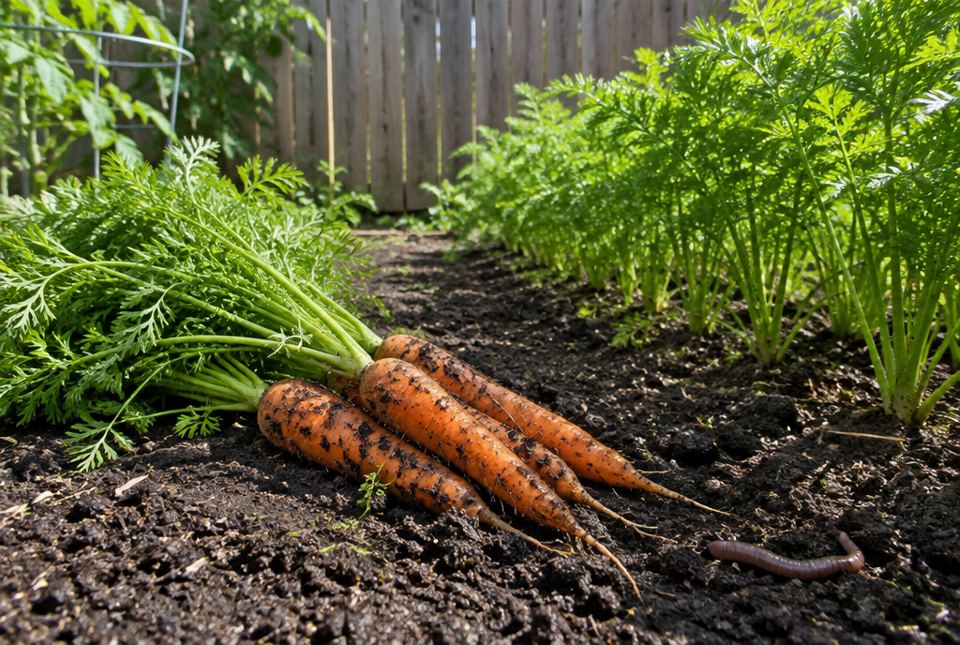 The setting of Mia's story is Grandpa's garden on a hot summer morning. Can you spot the carrots and the worm from the story? AI-generated image
| Story part | In My Day at Grandpa's Garden |
|---|
| Characters | Mia (I), Grandpa, and a worm |
| Setting: where | Grandpa's backyard garden |
| Setting: when | A hot summer morning |
| Narrator | Mia. She says "I", so she is telling her own story. |
Who is telling the story?
Look for the little word I.
- If the narrator says I, me and we, a character in the story is telling it. This is called first person. ("I pulled a carrot.")
- If the narrator says he, she, they or uses names, someone outside the story is telling it. ("Mia pulled a carrot.")
What if Grandpa told the story? He might say: "My granddaughter was scared of a worm, so I told her worms help gardens grow." Same story, different point of view!
Worked exampleLet's make an inference
The story does not say "Mia was scared." How do we know she felt scared of the worm?
- Find clues: "I jumped back and squeezed Grandpa's hand."
- Think: What do I do when I am scared? I jump back. I hold on to a grown-up.
- Put the clues and what I know together.
Mia felt scared (or surprised). The clues plus what we know helped us infer it.
Worked exampleLet's notice the writer's words
The writer says the carrots were crunchy and sweet. Why did she choose those words?
- Crunchy tells how the carrot sounded and felt.
- Sweet tells how it tasted.
- These words help us imagine eating the carrot.
Good word choice helps the reader picture, hear and taste the story. The writer's voice sounds happy and excited ("Wow!").
Just for funWhy did the worm love Grandpa's garden?
Because it really digs gardening! 🪱
Many ways to see things
Different characters can have different perspectives (ways of thinking or feeling). At first, Mia thought worms were yucky. Grandpa thought worms were helpful. When you read, ask: "How does this character feel about it? Would someone else feel differently?"
Hands-on activityTell it from the toy's point of view
You need: a favourite stuffed animal or toy.
- Tell a short story about your day using I: "I woke up. I ate cereal…"
- Now tell the same day as your toy: "My friend woke up. She put me on her bed…"
- Talk: How did the story change? What did the toy notice that you didn't?
Bonus: Draw the setting of your story: where and when it happened.
Your turn
1Who are the characters in My Day at Grandpa's Garden?
Mia, Grandpa and the worm.
Grandpa's backyard garden on a hot summer morning.
3Who is the narrator? How do you know?
Mia. She says "I" ("I pulled a carrot").
4How did Mia feel when she pulled out the carrot? Find a clue.
Excited / surprised. She said "Wow!"
5What did Grandpa say worms do?
They help the garden grow and make the soil healthy.
6Did Mia change her mind about worms? Find the sentence.
Yes, a little. "Maybe worms are not so bad."
7Tell one sentence of the story as if the worm were telling it.
Example: "I wiggled out of the dirt and a girl jumped back! I was only trying to help the garden grow."
More practice: warm-up
A person or animal in a story.
2What two things does a setting tell?
Where and when the story happens.
The one telling the story.
4If a story says "I went to the park," is the narrator a character in the story?
Yes. The word I tells us a character is telling it (first person).
5What did Mia and Grandpa eat for lunch?
More practice: on your own
1"Jake stamped his feet and crossed his arms when it was time for bed." How does Jake feel? What clues did you use?
Angry or upset. Clues: he stamped his feet and crossed his arms.
2Name the setting: "The bus drove through the dark, snowy streets on a winter night."
Where: the streets / on a bus. When: a winter night.
3"Tom kicked the ball." Who is telling this: Tom, or someone outside the story?
Someone outside the story. It uses Tom's name, not "I".
4Change this to first person: "Ella built a snowman."
5Mia thinks the carrots are the best food ever. Her brother hates carrots. Is it okay for them to have different perspectives?
Yes. People can feel differently about the same thing. Both perspectives are okay.
Challenge
1Why do you think Grandpa laughed when Mia jumped back?
Possible answer: Grandpa was not scared of worms. He knows worms are helpful, so Mia's jump seemed funny and cute to him. (He was laughing kindly, not to be mean.)
2Retell the worm part of the story from Grandpa's point of view, in two sentences.
Example: "My granddaughter found a worm and jumped back. I laughed and told her worms help my garden grow."
3The writer used the word wiggle for the worm. Think of another good word for how a worm moves. Why is it a good choice?
Examples: squirm, wriggle, slither. These words help you picture the worm's twisty movement.
Quiz
2. In My Day at Grandpa's Garden, who is the narrator?
3. Mia jumped back and squeezed Grandpa's hand. How did she feel?
4. Which sentence is told in first person?
5. What did Grandpa think about worms?
6. Figuring out something from clues is called making an…
Big idea: Children identify characters, settings and the narrator, notice first-person narration ("I"), imagine the story from another point of view, and make simple inferences about feelings from clues. They also start to see that different characters can have different perspectives, and notice how the writer's word choice and voice help create meaning.
How to help at home:
- Ask "How do you think she feels? How do you know?" Point to the face in the picture or to action words.
- Play "Who's telling?" with books: look for "I" versus names.
- Retell a familiar tale from another character's view (for example, the Three Bears' side of Goldilocks).
Common difficulties:
- Saying only "where" for the setting. Remind them a setting also has a when (season, time of day).
- Guessing feelings with no clue. Ask them to show you the words or picture that told them.
- Thinking a different opinion is wrong. Talk about how people can like different things.